
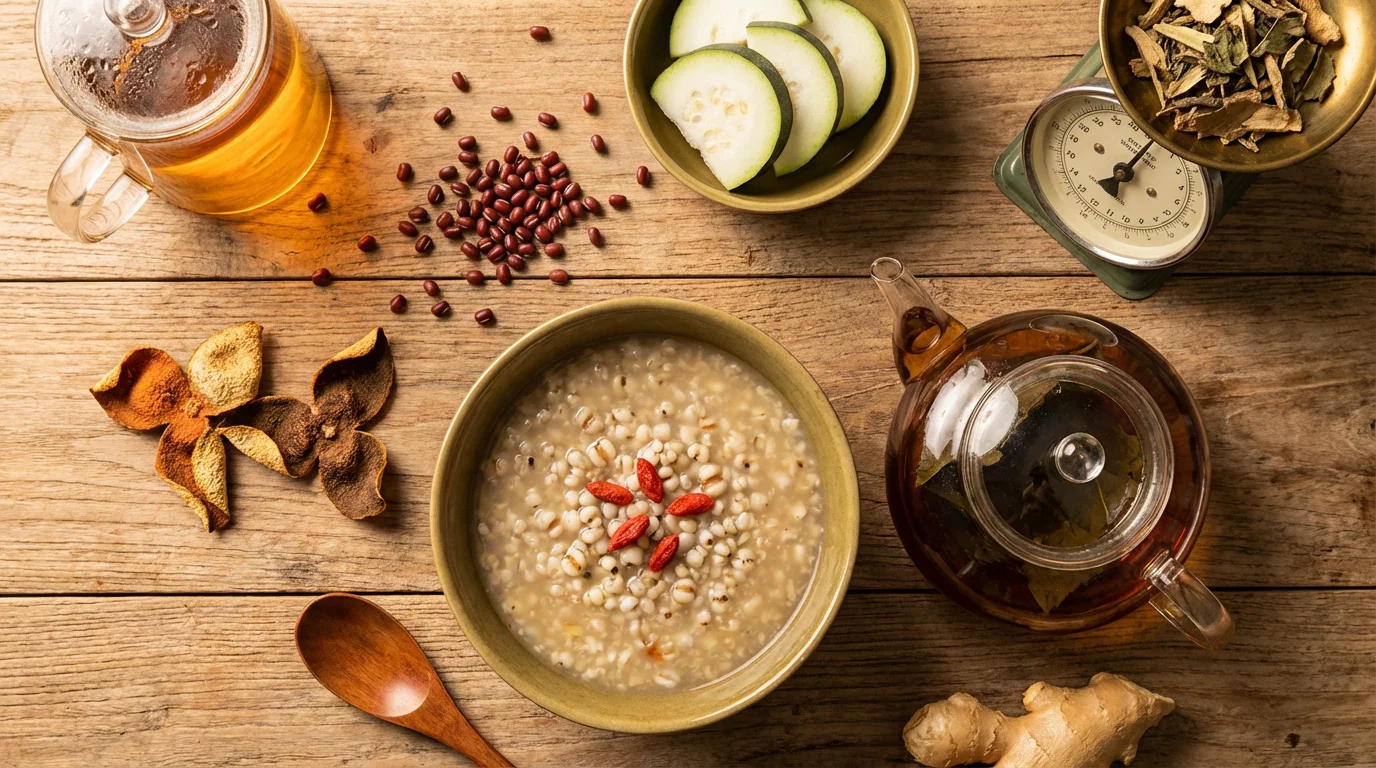
You've tried calorie counting. You've cut carbs, done intermittent fasting, exercised more. The scale moves - and then moves back. Or worse, it doesn't move at all despite doing everything right. If this is your experience, traditional Chinese medicine offers an explanation that modern nutrition science is only beginning to catch up with: your metabolism is not just a calorie equation - it's an organ function problem.
In TCM, excess weight and difficulty losing weight are almost always rooted in one or more of three organ system dysfunctions. Addressing these dysfunctions directly - through diet, herbs, and lifestyle - produces sustainable weight loss that calorie restriction alone cannot achieve.
The 3 Root Causes of Weight Gain in TCM
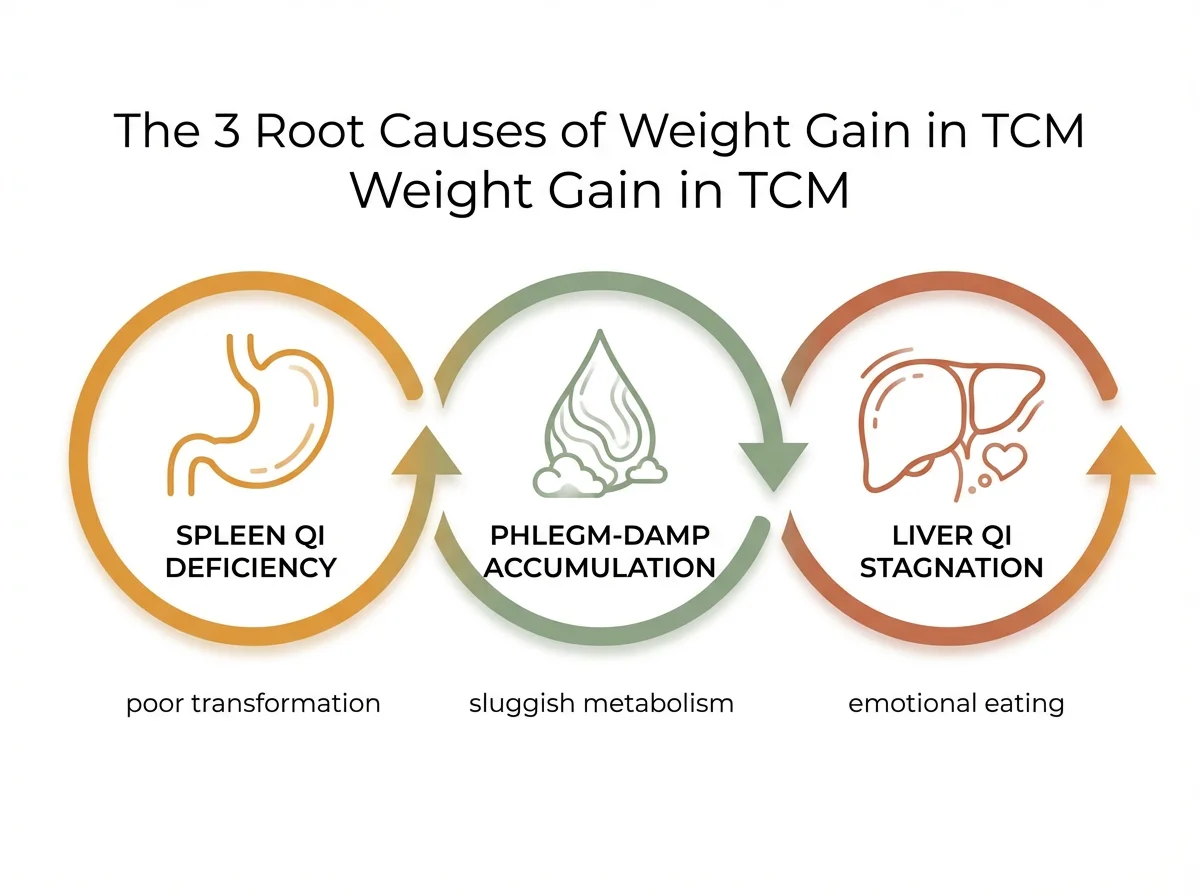
Root Cause 1: Spleen Qi Deficiency - The Metabolic Engine Fails
The Spleen in TCM is the primary organ of digestion and metabolism. When Spleen Qi is deficient, food is not properly transformed into usable energy - instead it accumulates as Damp (fluid retention, fat, mucus). This pattern produces a specific kind of weight gain: soft, water-retentive, concentrated in the abdomen and thighs, accompanied by fatigue after eating, bloating, and loose stools.
Key signs: Fatigue, bloating, loose stools, poor appetite, heavy feeling, inability to lose weight despite low calorie intake.
Root Cause 2: Phlegm-Damp Accumulation - Sluggish Metabolism
When Spleen Qi deficiency persists, it generates Phlegm-Damp - a TCM concept that maps closely to metabolic syndrome, insulin resistance, and visceral fat accumulation. Phlegm-Damp clogs the channels, slows circulation, and creates a self-reinforcing cycle: the more Damp accumulates, the harder the Spleen works, the more Qi it depletes.
Key signs: Overweight with heavy feeling, foggy head, chest tightness, excess mucus, sluggishness especially in the morning, weight concentrated in the belly.
Root Cause 3: Liver Qi Stagnation - Emotional and Hormonal Weight
Chronic stress causes Liver Qi to stagnate, disrupting the smooth flow of Qi and Blood throughout the body. This creates two weight-related problems: emotional eating (Liver overacts on Spleen, triggering sugar cravings under stress) and hormonal weight gain (Liver Qi stagnation impairs estrogen metabolism, leading to weight gain concentrated in hips and thighs).
Key signs: Weight gain during or after stressful periods, carb and sugar cravings, PMS-linked bloating, weight in hips/thighs, irritability.
Which Pattern Are You? Diagnostic Table
| Pattern | Weight Distribution | Energy | Digestion | Emotional Signs | Primary Fix |
|---|---|---|---|---|---|
| Spleen Qi Deficiency | Even distribution, soft/fluid | Chronically low, worse after eating | Bloating, loose stools, poor appetite | Worry, overthinking | Warm cooked diet, ST36 acupressure, Si Jun Zi Tang |
| Phlegm-Damp | Abdominal concentration, visceral fat | Heavy and sluggish, foggy morning | Bloating, excess mucus, poor appetite | Foggy, unmotivated | Yi Yi Ren, lotus leaf tea, aerobic exercise, Er Chen Tang |
| Liver Qi Stagnation | Hips/thighs, stress-triggered | Variable - exhausted but wired | IBS pattern, alternating stools | Irritable, frustrated, emotional eating | Rose tea, Xiao Yao San, aerobic exercise, LV3 acupressure |
| Yang Deficiency | Even, fluid-retentive, puffy | Always cold, low | Undigested food, loose stools, cold abdomen | Low mood, low motivation | Ginger, lamb, cinnamon, moxa on RN4, You Gui Wan |
The TCM Weight Loss Protocol
Diet: The Spleen-First Approach
Every TCM weight loss protocol begins with strengthening the Spleen - because without a functional metabolic engine, no diet produces lasting results. The Spleen-first diet rules:
- Eat warm and cooked - cold and raw foods suppress Spleen Yang, reducing metabolic rate and increasing Damp formation
- Eat at regular times - irregular eating disrupts Spleen rhythm; breakfast before 9 AM is essential
- Largest meal at lunch - Spleen function peaks 9 AM - PM; heavy evening meals become Damp
- Finish eating by 7 PM - evening eating after Spleen/Stomach hours generates Phlegm-Damp
- Reduce cold beverages - iced drinks are one of the most direct causes of Spleen Yang suppression
Top TCM Foods for Weight Management
| Food | TCM Action | Best For | How to Use |
|---|---|---|---|
| Job's Tears (Yi Yi Ren) | Resolves Dampness, strengthens Spleen, clears Heat | Phlegm-Damp pattern, fluid retention | Cook as porridge base with red bean; 30 - 0g daily |
| Lotus Leaf (He Ye) | Clears Summer Heat, resolves Dampness, lifts Spleen Yang | Abdominal obesity, Phlegm-Damp | Brew as tea (1 dried leaf per cup); drink before meals |
| Hawthorn (Shan Zha) | Moves food stagnation, dissolves fat, aids meat digestion | Food stagnation, high-fat diet, elevated lipids | Hawthorn tea after meals; 3 - dried slices per cup |
| Winter Melon (Dong Gua) | Clears Heat, resolves Dampness, promotes urination | Fluid retention, edema, abdominal bloating | Soup or stir-fry; winter melon and barley soup 3x/week |
| Fresh Ginger (Sheng Jiang) | Warms Spleen and Stomach, disperses Cold-Damp | Yang Deficiency and Spleen Qi Deficiency patterns | 3 slices in warm water every morning; add to all cooked meals |

Movement: Move Qi, Not Just Calories
In TCM, exercise for weight loss must match the pattern. Phlegm-Damp types need aerobic exercise that generates heat and moves Damp - brisk walking, swimming, dancing (30 - 5 minutes daily minimum). Spleen Qi Deficient types should avoid exhausting exercise that further depletes Qi - opt for Qi Gong, Tai Chi, and gentle walking instead. Liver Qi Stagnation types benefit most from aerobic exercise that "vents" stuck Qi - running, boxing, dancing.
Quick Reference: Weight Management at a Glance
| Question | Answer |
|---|---|
| Why can't I lose weight despite eating less? | Likely Spleen Qi Deficiency - the metabolic engine is weak, so even less food gets improperly transformed into Damp |
| What is Phlegm-Damp in modern terms? | Closest to metabolic syndrome, insulin resistance, and chronic low-grade inflammation |
| Best single food for weight loss? | Yi Yi Ren (Job's tears) + lotus leaf tea combination - resolves Damp and lifts Spleen Yang |
| Why does stress cause weight gain? | Liver Qi Stagnation - emotional eating + impaired estrogen metabolism - fat storage, especially hips and thighs |
| Best meal timing for weight management? | Large breakfast before 9 AM, largest meal at lunch, light dinner finished by 7 PM |
| How long for TCM weight protocols to show results? | 4 - weeks for bloating and fluid retention; 2 - months for sustained fat loss |
Find your TCM weight pattern and get a personalized diet and herb protocol at Lingcore Health RootNourish - your AI-powered TCM nutrition companion.