
Modern sleep science measures sleep in hours. Traditional Chinese Medicine measures it in timing. The distinction matters more than most people realize - and it is grounded in one of the most elegant frameworks in classical medicine: the theory of Nutritive Qi (Ying Qi) and Defensive Qi (Wei Qi) circulation, as described in Chapter 18 of the Lingshu, Ying Wei Sheng Hui ( - - - ) - "The Meeting of Nutritive and Defensive Qi."
According to this 2,000-year-old text, your body does not simply "rest" during sleep. It executes a precise, time-dependent sequence of repair, detoxification, and regeneration - one that can only happen when you sleep at the right time. Six hours of sleep starting at 10 PM is fundamentally different from six hours starting at 2 AM. Not just in how you feel, but in what actually gets repaired.
The Lingshu Framework: Ying Qi and Wei Qi
The Lingshu describes two forms of Qi that govern the body's daily cycle:
- Ying Qi ( - ? - Nutritive Qi): Flows inside the blood vessels and meridians. Nourishes the organs, builds Blood, and repairs tissue. Its circulation follows the 12-organ meridian sequence - completing one full circuit every 24 hours. This is the Qi that does the deep repair work of sleep.
- Wei Qi ( - ? - Defensive Qi): Flows on the body's surface and between the organs. Governs immune defense, body temperature, and the sleep-wake cycle. During the day, Wei Qi circulates on the exterior (keeping you alert and defended). At night, it moves inward - and this inward movement is what initiates genuine sleep.
The Lingshu states: "When Wei Qi enters the Yin (interior) at night, the person sleeps. When it returns to the Yang (exterior) at dawn, the person wakes."
The practical implication is profound: if you stay awake past the point when Wei Qi should be moving inward, you are working against your body's fundamental repair mechanism. You are, in TCM terms, forcing Wei Qi to stay on the exterior when it is designed to go inward - and every hour of this delay costs you repair capacity that cannot be fully recovered.
The TCM Nighttime Healing Clock
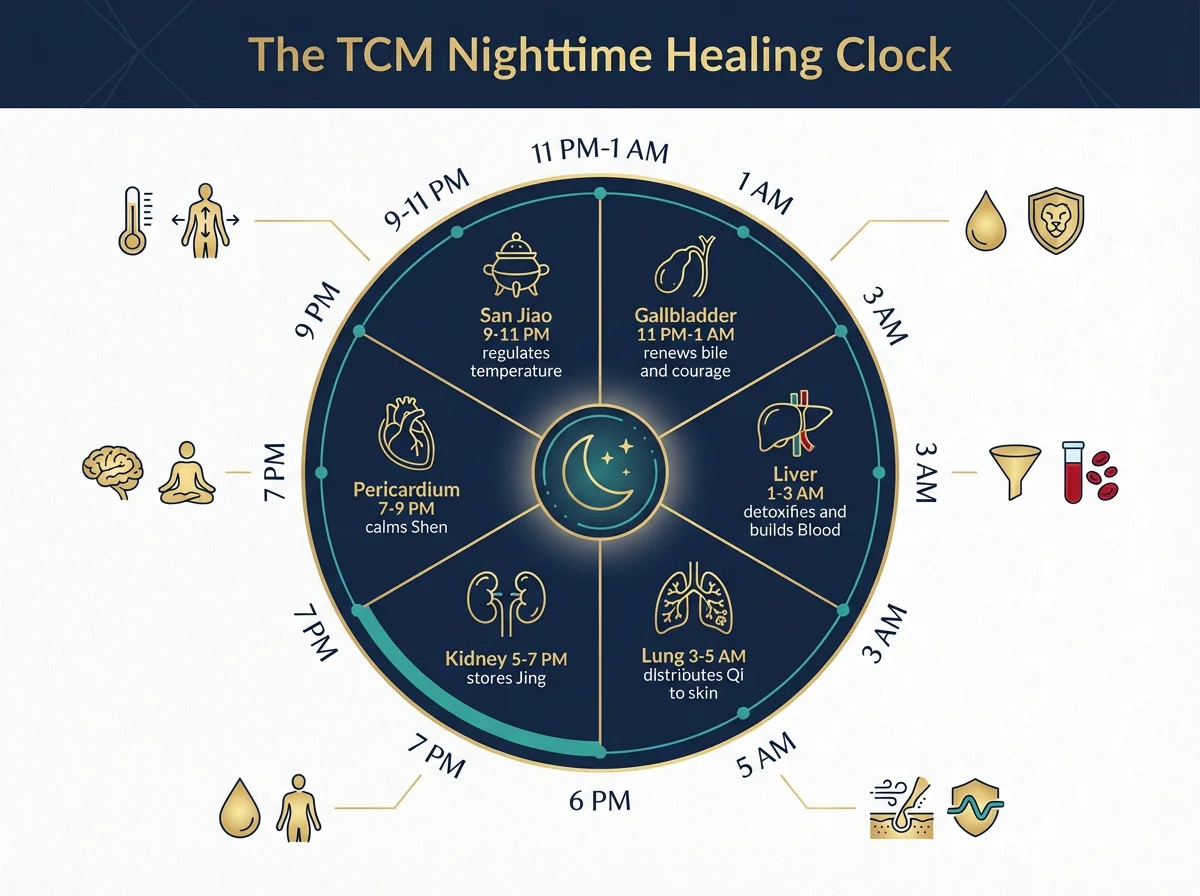
| Time Window | Peak Organ | Healing Function | What You Lose by Being Awake |
|---|---|---|---|
| 5 - PM | Kidney | Stores the day's surplus Jing; begins consolidating essence for overnight use | Working through this window depletes the reserves needed for overnight repair |
| 7 - PM | Pericardium | Calms the Heart Shen; transitions the nervous system from active to receptive mode | Screen use and stimulation during this window prevents Shen from settling - the root of "tired but wired" |
| 9 - 1 PM | San Jiao (Triple Burner) | Regulates body temperature and fluid metabolism; prepares all three body cavities for sleep | Staying up disrupts temperature regulation - causing the night sweats and restlessness that many people experience |
| 11 PM - AM | Gallbladder | Renews bile; processes emotional decisions; the "pivot" between Yin and Yang - the most critical sleep window | Missing this window is the single most damaging sleep habit in TCM. The Gallbladder's renewal cannot be "made up" later in the night |
| 1 - AM | Liver | Detoxifies Blood; regenerates Liver Blood; processes emotional experiences from the day | Waking at this hour indicates Liver overload. Being awake prevents Blood regeneration - the source of next-day brain fog, eye fatigue, and irritability |
| 3 - AM | Lung | Distributes freshly regenerated Qi and Blood to the skin and surface; governs the Wei Qi's return to the exterior | Waking between 3 - AM suggests Lung Qi or Yin deficiency. The Lung's distribution work at this hour explains why "beauty sleep" before midnight is physiologically real |
Why "Making Up Sleep" Doesn't Work in TCM
One of the most common modern sleep myths is that lost sleep can be recovered by sleeping longer on weekends. The Lingshu's framework explains why this is only partially true - and where it definitively fails.
Ying Qi and Wei Qi follow the sun. Their cycle is anchored to the Earth's day-night rhythm, not to your personal schedule. When you sleep from 2 AM to 10 AM, your body does receive the deep repair that happens during sleep - but it misses the specific organ-timed windows of the 11 PM - AM period. The Gallbladder's renewal and the Liver's Blood regeneration happen on a fixed schedule. Sleeping in cannot retroactively trigger those processes for the previous night.
This is why chronic night owls often feel a particular kind of depletion that extra sleep on weekends doesn't fix: dull eyes, poor emotional resilience, persistent mild brain fog, and a sense of never being fully restored. In TCM terms, they have Liver Blood and Gallbladder Qi deficiency - accumulated from years of missing the critical 11 PM - AM repair window.
The Lingshu Sleep Protocol: 5 Practices to Align With Your Healing Clock
1. The 9 PM Wind-Down Rule
The Pericardium hour (7 - PM) is when your nervous system begins transitioning to sleep mode. Stimulating inputs during this window - bright screens, stressful conversations, intense exercise, alcohol - directly prevent this transition. By 9 PM: dim lights, stop screens, switch to calm activities. This is not comfort advice; it is timing your Wei Qi's inward movement correctly.
2. The Suan Zao Ren Ritual
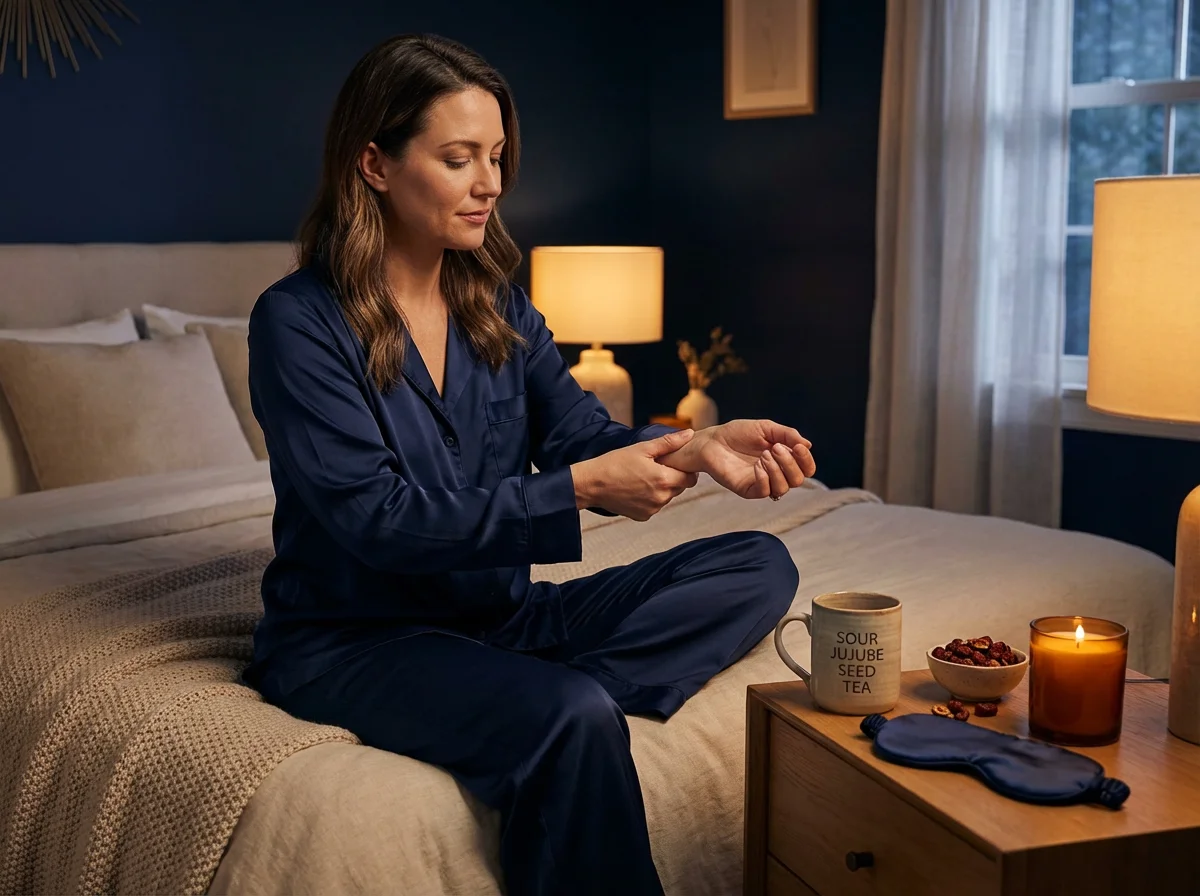
Brew 15 - 0g of crushed sour jujube seeds (Suan Zao Ren) in hot water for 20 minutes. Drink at 9:30 - 0 PM. Suan Zao Ren is the most studied TCM herb for sleep - it specifically nourishes Heart Blood and calms the Shen, facilitating the transition that the Pericardium hour initiates. Clinical studies confirm it reduces sleep onset time and improves sleep quality within 2 - weeks of consistent use.
3. Lights Out by 10:30 PM - Non-Negotiable
This gives your body 30 minutes to fall asleep before the Gallbladder hour begins at 11 PM. The Gallbladder's renewal work requires you to be in deep sleep - not just lying in the dark. If you consistently take more than 30 minutes to fall asleep, address the underlying pattern (most commonly Liver Qi Stagnation or Heart Blood Deficiency) rather than simply trying harder to sleep.
4. HT7 Acupressure Before Sleep
Press Shenmen (HT7) - located at the inner wrist crease on the ulnar side - firmly for 90 seconds on each wrist before lying down. HT7 is the Heart meridian's source point: it directly calms the Shen and nourishes Heart Blood, addressing the two most common causes of difficulty falling asleep. Works synergistically with Suan Zao Ren tea.
5. Address the 3 AM Wake Pattern
If you consistently wake between 1 - AM, the Lingshu's organ clock gives you a direct diagnosis: Liver overload. Common causes in modern adults: chronic stress accumulation, alcohol consumption (even moderate), late-night eating, and screen use into the night. The fix is addressed during the day and evening - not at 3 AM when you're already awake. Begin with: no alcohol, no eating after 7 PM, daily exercise to move Liver Qi, and LV3 acupressure each evening.
Quick Reference: The Lingshu Nighttime Healing Guide
| Question | Lingshu Answer |
|---|---|
| Is 8 hours of sleep always enough? | Only if timed correctly. 8 hours from 11 PM is far more restorative than 8 hours from 2 AM - the organ clock is fixed to solar time, not personal schedule |
| Most critical sleep window? | 11 PM - AM (Gallbladder hour) - the pivot between Yin and Yang. Missing this consistently creates cumulative depletion no amount of weekend sleep recovers |
| What causes "tired but wired"? | Wei Qi cannot complete its inward movement - usually due to screen light, stress, or stimulants preventing the Pericardium hour transition at 7 - PM |
| Best single herb for sleep timing? | Suan Zao Ren (sour jujube seed) - nourishes Heart Blood, calms Shen, clinically proven to improve sleep onset and quality |
| Why do I wake at 3 AM? | Liver organ clock peak - signals Liver overload from stress, alcohol, or late eating. Address the cause during daytime, not at night |
| Can weekend sleep fix weekday damage? | Partially - deep sleep repair can be recovered, but missed organ-clock windows (especially Gallbladder and Liver) cannot be retroactively triggered |
Medical Disclaimer: The information provided in this article is for educational and informational purposes only and is not intended as medical advice, diagnosis, or treatment. Always seek the advice of your physician or other qualified health provider with any questions you may have regarding a medical condition. Never disregard professional medical advice or delay in seeking it because of something you have read on this website. For more details, please visit our Medical Disclaimer page.
Get a personalized TCM sleep pattern assessment and a protocol aligned with your healing clock at Lingcore Health ShenRest - your AI-powered TCM companion for sleep and recovery.