
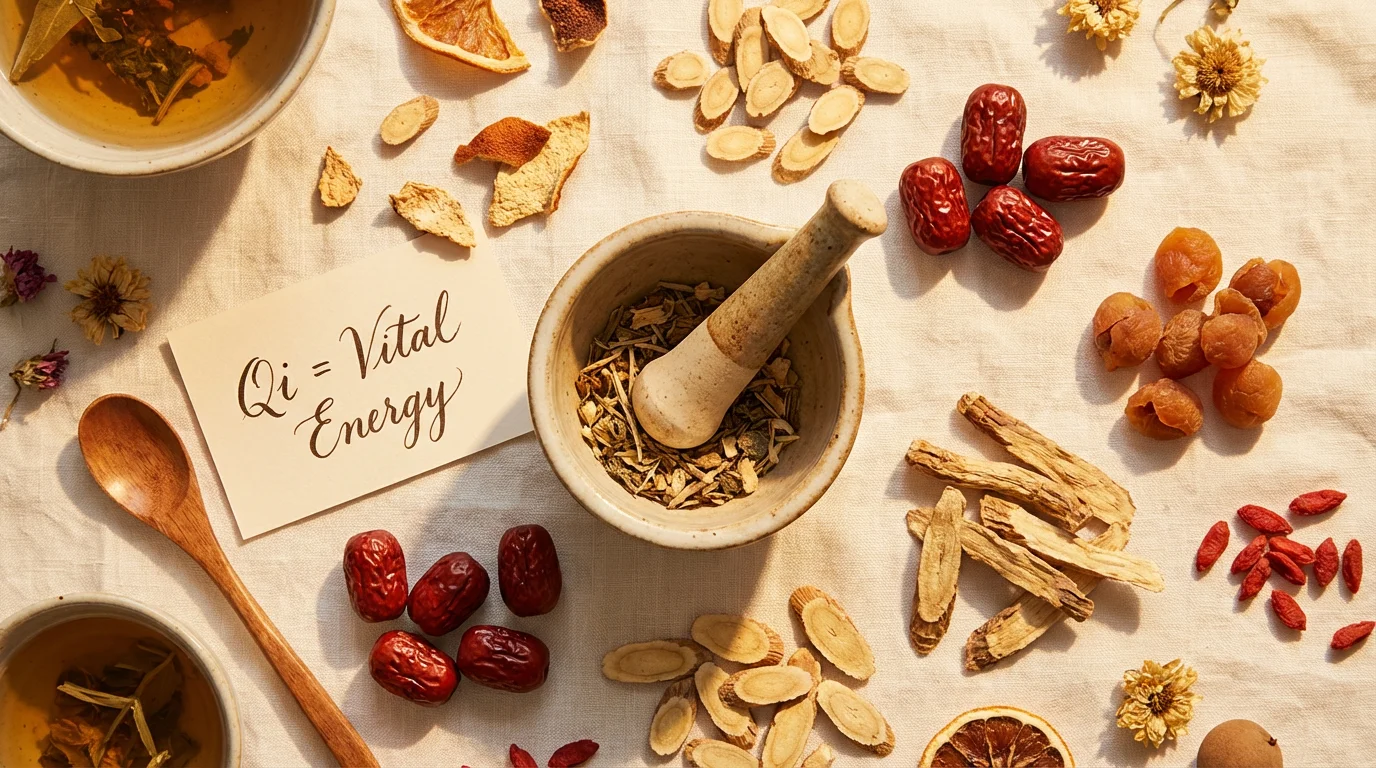
If you constantly feel tired despite adequate sleep, catch every cold that goes around, feel breathless climbing stairs, or find your voice is quieter than it used to be - you may be experiencing what Traditional Chinese Medicine calls Qi Deficiency ( - ?, Q? X?).
Qi (pronounced "chee") is the vital life force that powers every physiological process in the body. In TCM, it is not mystical - it is a functional concept describing the body's energy, immune activity, metabolic rate, organ function, and capacity for self-repair. When Qi is abundant, the body is vibrant, resilient, and self-regulating. When Qi is deficient, everything slows down.
What Is Qi - And Why Does It Get Depleted?
TCM describes multiple types of Qi, each with a specific function. The most clinically relevant for understanding "Qi Deficiency" are:
- Yuan Qi (Source Qi) - inherited from parents; the constitutional foundation of your vitality. Depleted by: chronic illness, aging, overwork, insufficient rest.
- Zhong Qi (Gathering Qi) - produced by breathing; governs lung and heart function. Depleted by: shallow breathing, sedentary lifestyle, air pollution.
- Ying Qi (Nutritive Qi) - extracted from food by the Spleen; nourishes the body. Depleted by: poor diet, skipping meals, cold/raw foods, digestive weakness.
- Wei Qi (Defensive Qi) - circulates on the body's surface; governs immune defense. Depleted by: chronic illness, Lung weakness, insufficient sleep.
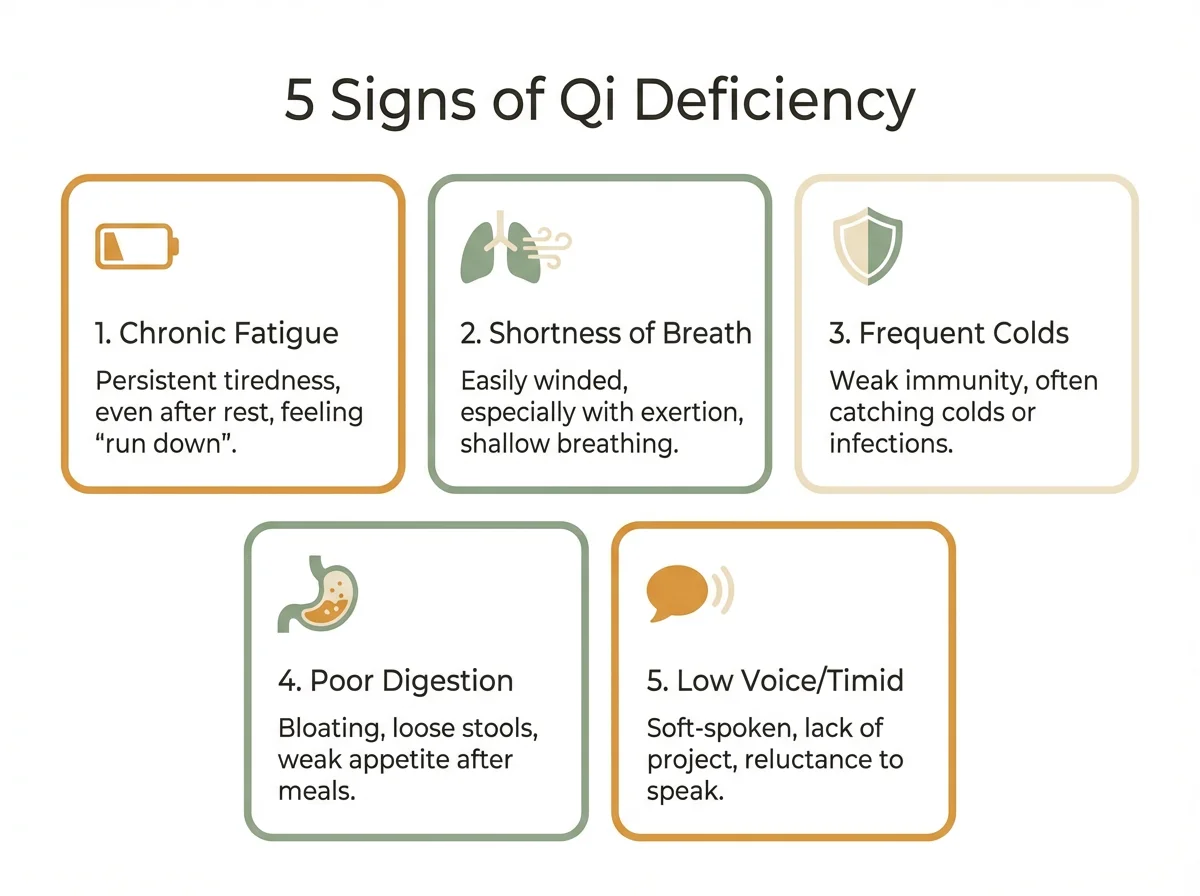
The 5 Key Signs of Qi Deficiency
| # | Sign | Why It Happens (TCM) | Modern Parallel |
|---|---|---|---|
| 1 | Persistent fatigue - tired even after sleep, low stamina | Insufficient Qi to power cellular and organ activity | Mitochondrial dysfunction, adrenal fatigue, hypothyroidism |
| 2 | Shortness of breath - winded easily, weak voice | Lung Qi insufficient to govern respiration and voice projection | Reduced lung capacity, low VO2 max |
| 3 | Frequent illness - catches colds easily, slow recovery | Wei Qi (defensive Qi) too weak to repel external pathogens | Compromised immune function, low NK cell activity |
| 4 | Poor digestion - bloating, loose stools, poor appetite | Spleen Qi insufficient to transform and transport food essence | Low digestive enzyme production, gut dysbiosis |
| 5 | Spontaneous sweating - sweats without exertion, especially on the face | Qi cannot consolidate the body's surface to hold fluids in | Autonomic nervous system dysregulation, hormonal imbalance |
Qi Deficiency by Organ System
| Type | Primary Symptoms | Secondary Symptoms | Best Foods | Key Herbs |
|---|---|---|---|---|
| Lung Qi Deficiency | Weak voice, shortness of breath, frequent colds, spontaneous sweating | Pale face, low immunity, chronic cough | Pear, lily bulb, white radish, almond, lotus seed | Huang Qi (Astragalus), Yu Ping Feng San |
| Spleen Qi Deficiency | Fatigue after eating, bloating, loose stools, poor appetite | Muscle weakness, prolapse, easy bruising | Millet, yam, pumpkin, beef, red dates, cooked rice | Si Jun Zi Tang, Dang Shen, Bai Zhu |
| Heart Qi Deficiency | Palpitations, fatigue, shortness of breath on exertion | Pale face, anxiety, spontaneous sweating | Longan, red dates, lotus seed, wheat germ | Zhi Gan Cao Tang, Ren Shen (Ginseng) |
| Kidney Qi Deficiency | Low back weakness, frequent urination, tinnitus, poor memory | Low libido, premature aging, hair loss | Black sesame, walnuts, black beans, bone broth | Jin Gui Shen Qi Wan, Tu Si Zi |
How to Rebuild Qi: The Complete Protocol
1. Astragalus (Huang Qi) - The Master Qi Tonic
Huang Qi is the single most important herb for Qi deficiency. It tonifies Spleen and Lung Qi, raises Yang, and powerfully strengthens Wei Qi (immune defense). Modern research confirms it stimulates T-cell and NK cell activity, reduces fatigue markers, and improves exercise endurance. Dose: 15 - 0g in decoction daily, or 500 - 000mg standardized extract. Simmer 3 - slices in bone broth or chicken soup as a culinary tonic.
2. ST36 (Zusanli) - The "Longevity Point"
Located 4 finger-widths below the kneecap, one finger-width lateral to the shinbone. Zusanli is the most important acupressure point for building Qi and Spleen function. Press firmly for 2 minutes each leg, twice daily. Clinical studies show regular stimulation of ST36 increases white blood cell count, improves digestive enzyme secretion, and reduces fatigue in cancer patients undergoing chemotherapy.
3. Qi Gong - Move to Build
Unlike Western exercise that can further deplete Qi in deficient individuals, Qi Gong generates and circulates Qi rather than consuming it. The "Eight Brocades" (Ba Duan Jin) sequence - 8 gentle standing movements - is the classical prescription for Qi deficiency. 15 - 0 minutes daily. Multiple RCTs confirm improvements in fatigue, immune function, and quality of life within 8 weeks.

4. Eat for Spleen Qi
Since Spleen Qi is the primary source of postnatal Qi production, optimizing digestion is the foundation of any Qi-building protocol. Key rules: eat warm and cooked foods only; eat at regular times (especially breakfast before 9 AM); avoid cold drinks, raw food, and excessive sugar; chew thoroughly; do not overeat. Add ST36 acupressure after every meal.
5. Sleep and Rest as Medicine
In TCM, rest is not passive - it is when Qi is consolidated and rebuilt. Sleep before 11 PM; aim for 7 - hours. Avoid overwork and excessive exercise during the rebuilding phase. A classical TCM proverb: "The superior physician rests before they are tired." Rebuilding from Qi deficiency requires treating rest as a clinical intervention, not a luxury.
Quick Reference: Qi Deficiency at a Glance
| Question | TCM Answer |
|---|---|
| What is Qi deficiency? | Insufficient vital energy to power organ function, immunity, digestion, and repair |
| Most common cause? | Overwork + poor diet + insufficient sleep - the modern lifestyle triad |
| Best single herb? | Huang Qi (Astragalus) - tonifies Spleen and Lung Qi, strengthens immunity |
| Best acupressure point? | ST36 (Zusanli) - the "longevity point"; builds Qi, immunity, and digestive function |
| Best exercise? | Qi Gong (Ba Duan Jin) - generates Qi rather than depleting it; 15 - 0 min daily |
| How long to recover from Qi deficiency? | Mild: 4 - weeks. Moderate: 3 - months. Severe/chronic: 6 - 2 months with consistent protocol |
| Which Lingcore Health product addresses Qi deficiency? | All four - Qi deficiency manifests differently across women's health, sleep, digestion, and athletic performance |
Find out which type of Qi deficiency is affecting you and get a personalized recovery plan at Lingcore Health - your AI-powered TCM health companion.