
You eat clean. More vegetables than most people see in a week. Zero processed meat. Maybe you have been plant-based for years. And yet - you are exhausted. Not just tired after a long day, but a deep, persistent fatigue that does not fully go away even after a good night of sleep. Your energy is flat. Your focus drifts. Sometimes you feel cold when others do not. You are doing everything "right," and something is still off.
This is one of the most common patterns we see in health-conscious eaters - and it is almost never about willpower or discipline. It is about a specific imbalance that plant-based diets, even very well-planned ones, can quietly create over time. Understanding it does not require giving up your values. It requires understanding what your particular body needs - and getting precise about how to provide it.
The Blood Deficiency Pattern: When "Healthy Eating" Is Not Enough
In classical Chinese medicine, Blood is not just the red liquid in your veins. It is a broader concept encompassing the nourishing, moistening, and sustaining aspect of the body's resources - what feeds the organs, the mind, and the nervous system at a deep level. Blood Deficiency is one of the most commonly identified patterns in clinical practice, and it is dramatically overrepresented in people who eat plant-based diets, especially women.
The symptoms are specific and recognizable:
- Fatigue that is worse in the afternoon and evening
- Difficulty falling asleep despite feeling tired
- Pale complexion, pale lips, or pale inner eyelids
- Hair that is thinning, dry, or shedding more than usual
- Dry skin and eyes - especially noticeable in winter or dry climates
- Feeling cold, particularly in the hands and feet
- Anxiety or excessive worrying, especially at night
- Periods that are lighter than they used to be, or irregular
If you recognize four or more of these, Blood Deficiency is very likely a significant part of your picture.
Why Plant-Based Diets Create This Pattern
This is not a criticism of plant-based eating. It is a recognition that the human body evolved needing certain nutrients in specific forms, and some of those forms are harder to obtain from plants alone.
| Nutrient | Why It Matters for Blood | Plant Challenge |
|---|---|---|
| Iron (heme form) | Core component of red blood cell production | Non-heme iron from plants absorbs at 2-20% vs 15-35% for heme iron |
| Vitamin B12 | Essential for red blood cell formation and nerve function | Found almost exclusively in animal products - supplementation required |
| Folate (food form) | Supports DNA synthesis in blood cells | Available in plants but destroyed by cooking - raw greens needed |
| Zinc | Immune function, hormone production, energy metabolism | Phytates in grains and legumes block absorption |
| Complete amino acids | Building blocks for hemoglobin and tissue repair | Requires deliberate food combining or whole protein sources |
The Classical Foods That Build Blood
The Suwen's chapter on organ-season-food relationships - the Zang Qi Fa Shi Lun - outlines which foods nourish which organ systems. The Spleen and Liver are the primary organs involved in Blood production and storage. Foods that support these systems are specific, and many of them are plant-based.
Dark-colored foods (classical Blood tonics)
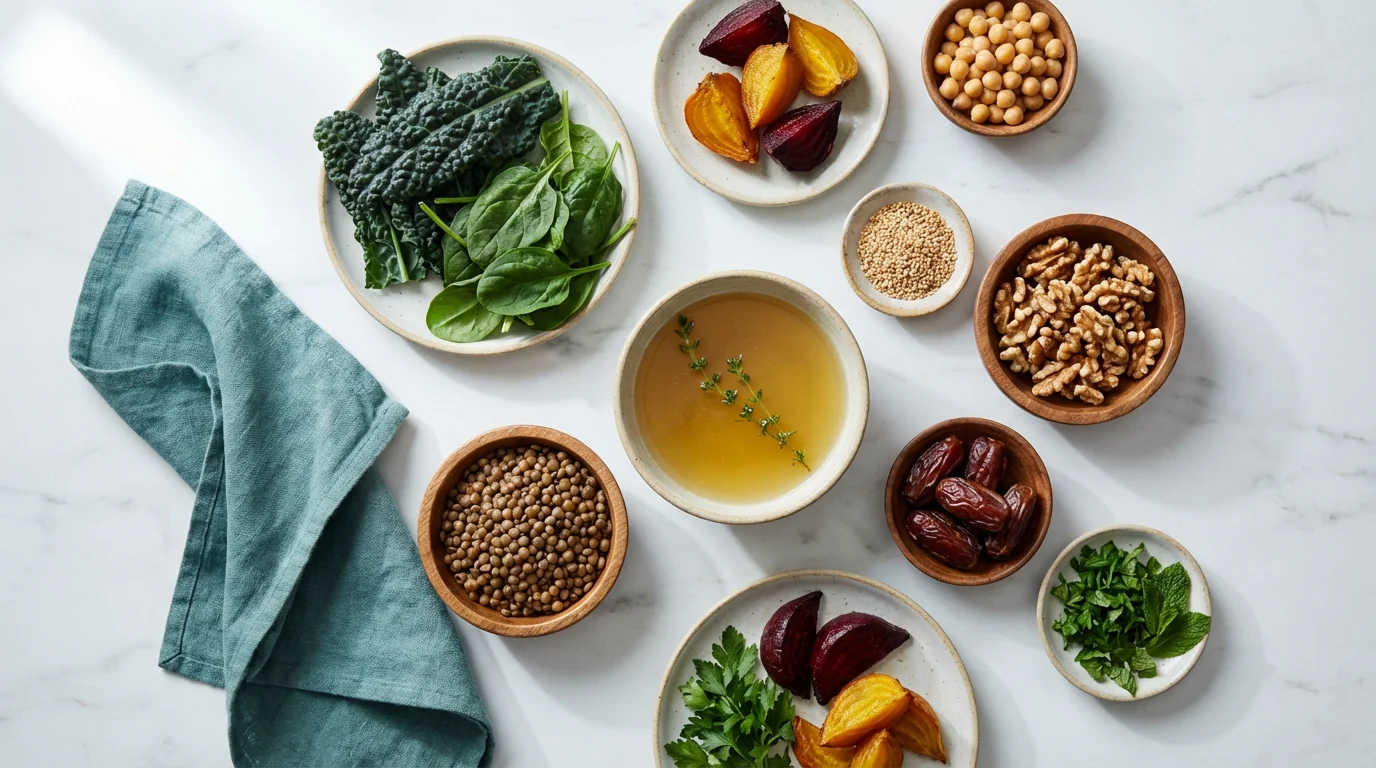
Black sesame seeds, dark kidney beans, black beans, dried mulberries, goji berries, beets, blackberries. The classical principle is that dark red and black foods nourish Blood directly - this aligns closely with modern understanding of their iron and anthocyanin content.
Iron-rich plant foods eaten with absorption enhancers
Lentils, spinach, pumpkin seeds, tofu, tempeh - always paired with vitamin C sources (lemon juice, bell peppers, tomatoes) to maximize non-heme iron absorption. Avoid drinking tea or coffee within an hour of these meals, as tannins significantly block iron uptake.
Warming, cooked foods over raw
This surprises many plant-based eaters. The classical texts consistently emphasize that cold and raw foods tax Spleen Qi - the digestive energy responsible for converting food into Blood. A large raw salad every day may actually be depleting your blood-building capacity. Lightly cooked, warm meals are dramatically easier for a Spleen-deficient system to process and use.
Adequate healthy fats
Walnuts, avocado, flaxseed, olive oil. Classical texts describe fats as essential for "moistening" - which maps to their role in fat-soluble vitamin absorption (A, D, E, K) and hormone production, both critical for Blood quality.
The Eating Timing Question
Blood is built primarily by the Spleen (9 AM to 11 AM) and stored by the Liver (1 AM to 3 AM). This means:
- Your most nourishing meal should be eaten before noon when digestive energy is highest
- Skipping breakfast or eating a very light morning meal is particularly costly for Blood Deficiency patterns
- Eating late at night (after 9 PM) interferes with the Liver's storage function during the 1-to-3 AM window
- Irregular meal timing - skipping, rushing, or eating on the go - directly weakens Spleen Qi over time
When to Suspect Something More Specific
Blood Deficiency rarely exists in isolation. It is almost always combined with at least one of the following:
| Combined Pattern | Extra Symptoms | What This Means |
|---|---|---|
| Blood Deficiency + Qi Deficiency | Shortness of breath, weak voice, heavy limbs | Both energy and nourishment are low - most common in long-term vegans |
| Blood Deficiency + Yin Deficiency | Night sweats, afternoon heat, restless sleep | Cooling and nourishing resources both depleted |
| Blood Deficiency + Liver Qi Stagnation | Irritability, PMS, irregular periods, sighing | Common in women with stress + plant-based diet |
Identifying your specific combination is what determines which foods and habits will actually move the needle for you - and which ones, however healthy they appear on paper, are not what your body needs right now.
Get Personalized Guidance - Not Generic Advice
The frustrating thing about fatigue in plant-based eaters is that generic advice - "eat more iron," "supplement B12" - often helps a little but not enough, because it does not account for the full picture. Your digestion, your stress level, your sleep, your hormonal patterns, and your eating timing all interact.
RootNourish by Lingcore Health is built to address exactly this complexity. You describe how you feel today - your energy, your digestion, your sleep, your cycle - and your AI coach gives you 3 to 5 specific, practical daily actions tailored to your current pattern. Not a generic vegan meal plan. Not a supplement protocol. Guidance based on your body, adapted as your pattern shifts.
Start your free 3-day trial and find out what your body actually needs. Try RootNourish free for 3 days - then $19.99/month.
Medical Disclaimer: The information provided in this article is for educational and informational purposes only and is not intended as medical advice, diagnosis, or treatment. Always seek the advice of your physician or other qualified health provider with any questions you may have regarding a medical condition. Never disregard professional medical advice or delay in seeking it because of something you have read on this website. For more details, please visit our Medical Disclaimer page.