

Introduction: The Modern Epidemic of the 'Tired but Wired' State
In our hyper-connected, fast-paced modern world, a peculiar phenomenon has become increasingly common: the sensation of being physically exhausted yet mentally hyper-active. You might find yourself staring at the ceiling at 2 AM, your body feeling like lead, while your mind races through tomorrow's to-do list, past conversations, or abstract anxieties. This is the "Tired but Wired" paradox. In Traditional Chinese Medicine (TCM), this isn't just a sign of a busy life; it is a clinical pattern known as Yin Deficiency with Empty Heat.
This state is more than just occasional insomnia. it's a profound imbalance where the body's internal resources have been overextended for so long that the mechanism for rest itself has become damaged. When we look at health through the lens of Yin and Yang, we begin to see that this paradox is the natural outcome of a lifestyle that prioritizes Yang (activity, output, heat) at the expense of Yin (rest, nourishment, cooling).
The Foundations: Understanding Yin and Yang in the Context of Energy
Yin and Yang are the fundamental forces of the universe in TCM philosophy. Yang represents the active, masculine, bright, and hot aspects of life. It is the fire that drives our metabolism, the focus that allows us to work, and the energy that moves our limbs. Yin, conversely, represents the receptive, feminine, dark, and cool aspects. It is the fluid that lubricates our organs, and the stillness that allows for deep, restorative sleep.
Health is defined as the dynamic balance between these two forces. When Yang is high, we are productive and energetic. When Yin is high, we are restful and grounded. However, problems arise when one is sacrificed for the other. In our society, we are conditioned to believe that "more is better"—more work, more caffeine, more screen time. This constant demand for Yang energy slowly but surely erodes our Yin reserves, leading us toward the "Tired but Wired" state.
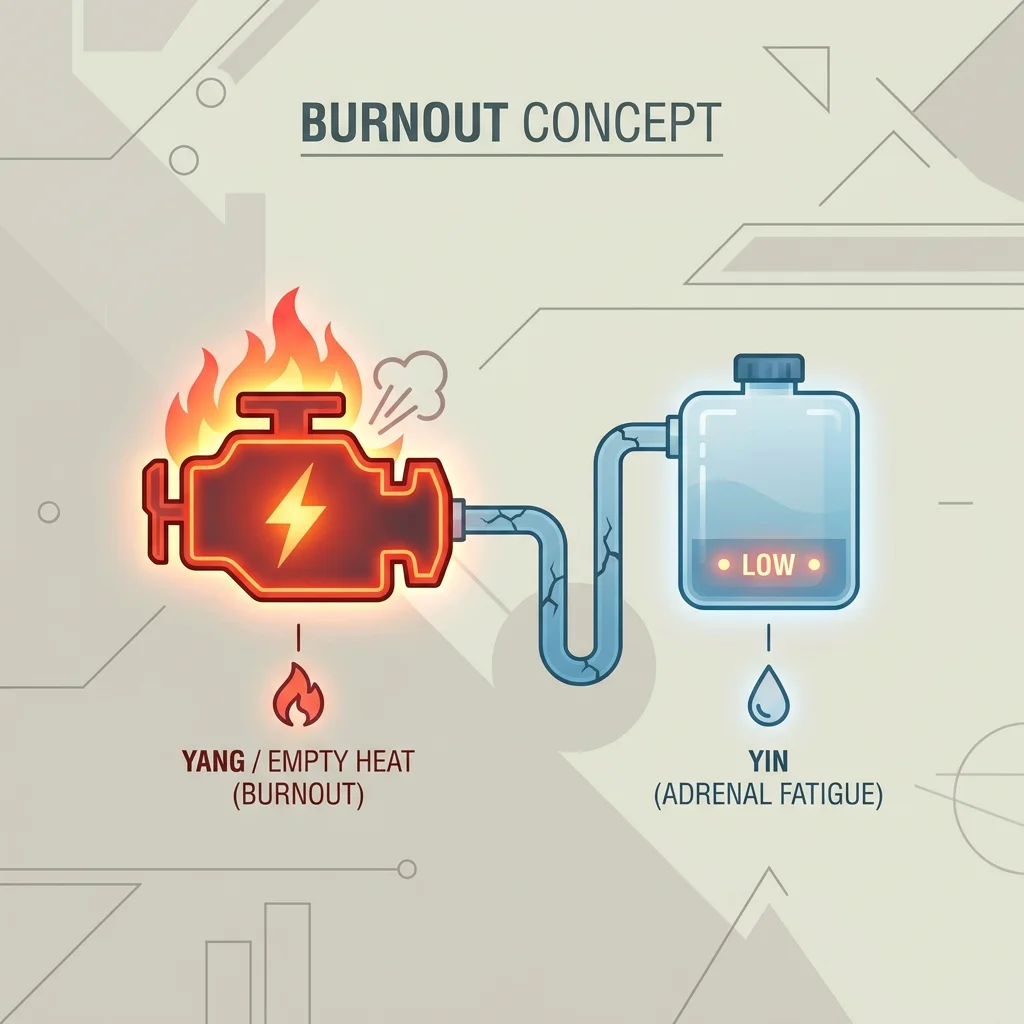
The Engine and Coolant Analogy: A TCM Perspective on Burnout
To better understand this, consider the analogy of a high-performance sports car engine. Yang is the combustion, the spark, and the power that turns the wheels. Yin is the radiator fluid, the coolant that keeps the engine from melting down under the pressure of high speeds. If you drive that car at 100 mph for weeks without checking the coolant levels, the engine will eventually start to smoke. Even if you turn the ignition off, the engine remains scorching hot to the touch. It cannot cool down because there is no fluid left to absorb the heat.
In your body, the "coolant" is your Yin. Chronic stress, lack of sleep, and overstimulation act like a leak in your radiator. As your Yin levels drop, your Yang (your internal fire) has nothing to anchor it. This creates what TCM calls "Empty Heat" or "False Heat." It’s called "empty" because it’s not caused by too much actual fire, but rather by too little cooling fluid. This is why you feel "wired"—your internal engine is overheating because the coolant is gone.
Empty Heat: Why You Feel Hot and Anxious
Empty Heat manifests in very specific ways. Because there isn't enough Yin to anchor the Yang, the heat rises to the upper part of the body. This leads to symptoms such as a racing heart, a dry throat, red cheeks (malar flush), and a restless mind. You might feel a "frantic" energy in your chest—a sense of urgency that has no clear source. This is the "wired" part of the paradox.
Unlike "Full Heat" (like a fever from an infection), Empty Heat is often worse in the evening and at night. This is because the evening is the time when Yin energy is supposed to be at its peak. If your Yin is deficient, the lack of balance becomes most apparent when the sun goes down, leading to night sweats, "five-center heat" (hot palms, soles, and chest), and the inability to fall into a deep sleep.
The Organ Clock: 3 PM Crashes and Midnight Spikes
TCM utilizes the "Organ Clock," a system that maps the flow of Qi (energy) through different organs over a 24-hour cycle. Understanding this clock can reveal why your "Tired but Wired" symptoms peak at certain times. For many with Yin Deficiency, the 3 PM to 5 PM window (Bladder/Kidney time) is marked by a significant energy crash. This is the moment your body realizes its "coolant" levels are critically low.
However, the most frustrating part of the cycle often happens between 11 PM and 3 AM (Gallbladder/Liver time). This is the "Yang within Yin" time. If your Yin is too weak to anchor the rising Yang during these hours, you will experience a "second wind" or a "midnight spike." Your mind becomes incredibly sharp and active just as you should be in your deepest sleep. This midnight wakefulness is a hallmark of Kidney and Liver Yin Deficiency.
Case Study: James, the Hedge Fund Manager
James was a 42-year-old hedge fund manager who came to us complaining of "permanent exhaustion." He was successful, but he was living on five espressos a day and working 14-hour shifts. He told us, "I'm so tired I could fall over, but as soon as my head hits the pillow, my brain starts spinning like a centrifuge. I feel hot, I get restless legs, and I can't stop thinking about trade entries."
Upon assessment, James showed classic signs of Yin Deficiency. His tongue was red and peeled, and his pulse was thin and rapid. He was the quintessential "sports car with no coolant." We started him on a protocol to "anchor the Shen" (the spirit) and nourish his Yin. Within three weeks of reducing his caffeine intake, adding Yin-nourishing foods, and practicing specific breathing techniques, James reported that his "internal vibration" had finally stopped. He was finally able to sleep through the night without feeling like his chest was on fire.
The 3-Step ShenRest Protocol to Restore Balance
If you identify with the "Tired but Wired" state, you need a structured approach to rebuild your Yin. The ShenRest Protocol is designed to cool the Empty Heat and replenish your internal fluids.
Step 1: Anchoring the Shen
The "Shen" is the spirit that resides in the Heart. When Yin is low, the Shen becomes "unanchored," leading to anxiety and racing thoughts. Use "Box Breathing" (inhale 4, hold 4, exhale 4, hold 4) for five minutes before bed. This physical regulation of the breath signals the nervous system to move out of "fight or flight" and allows the Shen to descend into a state of rest.
Step 2: Nourishing the Roots
You cannot think your way out of Yin Deficiency; you must nourish your way out. This means consuming foods that are hydrating and grounding. Avoid "heating" substances like coffee, alcohol, and spicy peppers, which further deplete your Yin. Instead, focus on the "Black and Green" strategy—black beans, black sesame seeds, and dark leafy greens. These are traditionally used in TCM to build Kidney Yin.
Step 3: Regulating the Cycle
Respect the Organ Clock. Try to be in bed and asleep before 11 PM to capture the peak Yin energy of the night. If you experience a 3 PM crash, instead of reaching for more caffeine, try a 15-minute "Yoga Nidra" session or a brief period of total darkness. This "micro-rest" helps prevent the total depletion that leads to the midnight spike.
Yin-Nourishing Foods: Your Internal Radiator Fluid
To rebuild your Yin, incorporate these foods into your daily diet:
- Black Sesame Seeds: A powerhouse for Kidney Yin and Essence.
- Seaweed and Kelp: Salty and cooling, they help nourish the fluids and minerals in the body.
- Cucumbers and Celery: Highly hydrating and cooling for the Liver.
- Goji Berries: Known to nourish both Liver and Kidney Yin.
- Pork or Bone Broth: Rich in collagen and minerals, providing deep nourishment for the "structural" Yin of the body.
- Mung Beans: Excellent for clearing "Empty Heat" from the system.

Conclusion: The Path Back to Deep Rest
Being "Tired but Wired" is your body's SOS signal. It is a warning that your internal resources are nearly dry. By understanding the balance of Yin and Yang, you can stop treating the symptoms (the anxiety, the heat, the insomnia) and start addressing the root cause: Yin Deficiency. Rest is not a luxury; it is the essential coolant that allows your high-performance life to continue without a total engine failure.
Ready to dive deeper?
>> Unlock Your ShenRest AI Coach Today <<
Medical Disclaimer: The information provided in this article is for educational and informational purposes only and is not intended as medical advice, diagnosis, or treatment. Always seek the advice of your physician or other qualified health provider with any questions you may have regarding a medical condition. Never disregard professional medical advice or delay in seeking it because of something you have read in this article. For more details, visit our Medical Disclaimer page.