

The Sugar Spike and the Spleen: A TCM Perspective on Metabolic Health
In the high-speed landscape of modern biohacking and metabolic optimization, the "sugar spike" is often discussed in purely biochemical terms. We track our blood glucose with continuous monitors, obsess over insulin sensitivity, and calculate the glycemic index of every morsel. While these Western metrics are invaluable, they often overlook the energetic toll that refined sugar takes on the body's primary metabolic engine. In Traditional Chinese Medicine (TCM), this engine is the Spleen (Pi). To achieve "Gold Standard" health, we must understand that a sugar spike is not just a physiological event; it is an energetic assault on the very foundation of our vitality, affecting everything from our cognitive clarity to our long-term cellular resilience.

The Spleen: The Minister of Transformation and Transportation
In TCM theory, the Spleen is the central hub of the Earth element. It is responsible for "Transformation and Transportation" (Yun Hua). Unlike the anatomical spleen of Western medicine, the TCM Spleen system encompasses the entire digestive process, the extraction of nutrients, and the distribution of energy (Qi) and blood to the rest of the body. It is the "root of post-natal Qi," meaning every ounce of energy you have to think, move, and heal comes from the Spleen's ability to process what you eat and drink. The Spleen works in close partnership with the Stomach, where the Stomach "rots and ripens" the food, and the Spleen extracts the essence.
The Spleen is often compared to a boiling cauldron or a transformative fire. It requires a specific environment to function: it loves "warmth and dryness" and loathes "cold and dampness." When we consume food, the Spleen's job is to "cook" that food energetically, extracting the Gu Qi (Food Essence) and sending it upward to the Lungs and Heart to be combined with air and turned into blood. When the Spleen is strong, we feel light, focused, and energized. When it is weak, we become a breeding ground for metabolic dysfunction, chronic fatigue, and systemic inflammation.
The Anatomy of an Assault: Why Refined Sugar is the Pathological Sweet
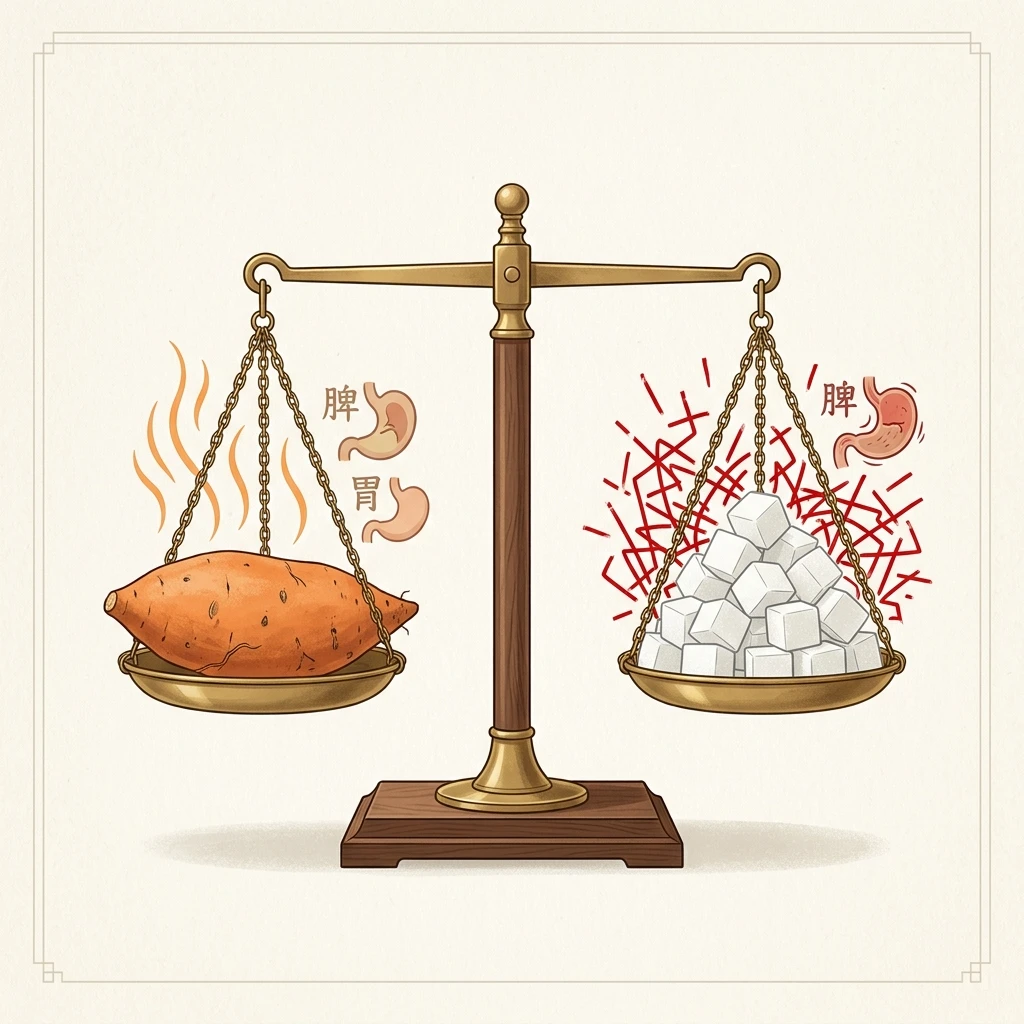
In the Five Element theory, each organ system is associated with a specific flavor that resonates with its energetic frequency. The flavor of the Spleen and the Earth element is "Sweet." In its natural form--the subtle, complex sweetness of a roasted yam, a carrot, or whole grains--the sweet flavor actually tonifies (strengthens) the Spleen. It provides the steady, slow-burning fuel the "cauldron" needs to stay lit and maintain a consistent metabolic temperature.
However, refined sugar represents "extreme sweetness." It is a concentrated, hyper-palatable substance that the human Spleen was never evolved to handle. When you consume a high-sugar snack or a refined carbohydrate, the energetic equivalent of an explosion occurs in the Spleen system. Instead of a steady flame, you are throwing high-octane gasoline onto the fire. This causes the Spleen's Qi to surge momentarily and then collapse, creating the classic "spike and crash" cycle that destabilizes the entire endocrine system.
1. The Generation of Internal Dampness: The Metabolic Sludge
The Spleen's most significant enemy is Dampness (Shi). Dampness is a TCM concept describing a heavy, sticky, and sluggish pathogen that accumulates when the Spleen cannot process fluids or nutrients effectively. Think of refined sugar as "liquid dampness." Because it is so concentrated and unnatural, the Spleen cannot "transform" it quickly enough. The excess sugar turns into a metabolic sludge--what we call Dampness. This dampness clogs the meridians, slows down the circulation of Qi, and settles in the tissues. This is the TCM explanation for the formation of adipose tissue (fat) and the feeling of "heaviness" that accompanies metabolic syndrome. This sludge also "clouds the clear Yang," leading to the brain fog that so many experience after a high-carb meal.
2. Dousing the Digestive Fire (Spleen Yang)
To process the massive influx of glucose, the Spleen must work overtime, drawing on its reserves of "Yang Qi" (the digestive fire). Over time, repeated sugar spikes exhaust this fire. This leads to a condition called Spleen Yang Deficiency. When the fire is low, the body can no longer extract nutrients effectively, even from healthy food. The "cauldron" becomes cold, and the food sits undigested, further creating dampness. This is why people with sugar-heavy diets often feel malnourished and exhausted despite consuming thousands of calories; they are effectively "starving in the midst of plenty" because their Spleen fire has been extinguished.
3. Qi Stagnation and the Blood Sugar Roller Coaster
The rapid rise and fall of energy associated with a sugar spike creates a state of "Qi Stagnation." The energy moves in fits and starts rather than a smooth, continuous flow. This stagnation creates internal heat, which further dries up the body's healthy fluids (Yin), leading to inflammation and cellular aging. This is the TCM explanation for oxidative stress and advanced glycation end-products (AGEs) that Western science links to high blood sugar. The body is essentially "baking" itself from the inside out due to the heat generated by the stagnant sugar-energy.
The Triple Burner and the Distribution Crisis
In TCM, the Triple Burner (San Jiao) is the system responsible for the movement of fluids and Qi through the three cavities of the body. When the Spleen is overwhelmed by sugar, the Triple Burner becomes obstructed. The "Upper Burner" (Heart and Lungs) becomes overheated, leading to anxiety and palpitations. The "Middle Burner" (Spleen and Stomach) becomes stagnant, leading to bloating. The "Lower Burner" (Kidneys and Bladder) becomes heavy, leading to edema and fluid retention. A sugar spike is therefore a systemic crisis that affects the entire architecture of human energy distribution.
The Vicious Cycle: Spleen Deficiency and the "False" Cravings
This is the most insidious part of the sugar spike: it creates its own demand. When the Spleen is weakened by sugar and bogged down by Dampness, it becomes desperate for energy. Because it can no longer extract slow, stable energy from complex foods, it sends out "emergency" signals for quick energy. This manifests as intense sugar cravings. You eat sugar because your Spleen is weak, and your Spleen is weak because you eat sugar. Breaking this cycle requires more than just willpower; it requires a systematic "Spleen Rescue" protocol that restores the Spleen's fire and drains the dampness.
Signs Your Spleen is Struggling with Sugar
If you are experiencing any of the following, your "Minister of Transformation" is under duress:
- Post-Meal Lethargy: The "food coma" is a sign your Spleen has diverted all its Qi to deal with the sugar assault.
- Heavy Limbs: A feeling that your arms and legs are weighted down, a classic sign of Dampness in the muscles.
- Bloating and "Sticky" Digestion: Gas, bloating, and irregular stools that feel "incomplete."
- Brain Fog and Focus Issues: Dampness "clouding the portals" of the mind.
- The Scalloped Tongue: If the edges of your tongue have teeth marks, your Spleen is too swollen with Dampness to fit properly in your mouth.
- Cravings for Sweets: Particularly after a meal, indicating the Spleen's inability to extract nutrients.
The RootNourish Spleen Rescue Protocol
At RootNourish, we believe that metabolic health is built from the ground up. To stabilize your blood sugar and restore your Spleen, follow these five pillars of the Gold Standard 3.0 protocol. This protocol is designed to reignite your digestive fire while simultaneously clearing the metabolic sludge that has accumulated over years of sugar consumption.
1. Prioritize Warm, Cooked Foods: Externalizing the Digestion
Give your Spleen a break by doing the "cooking" outside of your body. Avoid raw salads, smoothies, and ice-cold drinks, especially during your recovery phase. Raw food requires a massive amount of Spleen Yang to process. Opt for soups, stews, and roasted vegetables. The warmth of the food supports the Spleen's Yang and helps melt away stagnant Dampness. Think of it as providing a warm blanket for your digestive system.
2. The Power of "Natural Sweetness": Re-Education of the Palate
Instead of refined sugar, satisfy the Spleen's need for the sweet flavor with Earth-element foods: sweet potatoes, pumpkins, carrots, parsnips, and well-cooked grains like millet or brown rice. These foods provide a "steady burn" that tonifies the Spleen without causing a spike. They provide the "energetic information" the Spleen needs to feel safe and satisfied. Over time, your palate will reset, and you will find refined sugar to be cloying and unpleasant.
3. Aromatic Herbs for Dampness Drainage and Fire Support
Incorporate herbs that "awaken the Spleen" and "drain Dampness."
- Ginger: The ultimate Spleen-warmer. It stimulates circulation and aids in the transformation of food.
- Cinnamon (Gui Zhi/Rou Gui): Helps to warm the Kidneys and support the Spleen Yang. Studies show it improves insulin sensitivity.
- Cardamom: An aromatic herb that "breaks up" dampness and phlegm in the middle burner.
- Citrus Peel (Chen Pi): Regulates Qi and prevents the stagnation that occurs after eating.
4. Mindful Rhythms: The Spleen's Chronobiology
The Spleen thrives on regularity. Eating at the same times every day allows the Spleen to prepare its "fire" for the incoming task. Avoid late-night eating, as the Spleen's energy is lowest in the evening (7 PM - 11 PM). The hours of 7:00 AM to 9:00 AM (Stomach time) and 9:00 AM to 11:00 AM (Spleen time) are when your digestive fire is strongest. Make breakfast your most substantial and warming meal to set the tone for metabolic stability throughout the day.
5. Acupressure: The Manual Override
Stimulate specific points to boost Spleen function:
- Spleen 6 (San Yin Jiao): The intersection of the Spleen, Liver, and Kidney meridians. Massaging this point helps to regulate fluids and calm the mind.
- Stomach 36 (Zu San Li): Known as the "Point of a Hundred Diseases," it strengthens the Spleen and Stomach and boosts overall Qi.

Conclusion: From Spikes to Sustained Vitality
Metabolic health is not a battle of numbers; it is a cultivation of internal harmony. When you view the "sugar spike" through the lens of the Spleen, you realize that every choice is an opportunity to either douse your fire or nourish your roots. By choosing warm, whole foods and honoring the rhythms of your Spleen, you move beyond the roller coaster of cravings and fatigue. You enter a state of sustained vitality, where your energy is as steady and reliable as the Earth itself. You no longer have to fight your body; you are finally working with it.
>> Unlock Your AI Nutrition Coach <<
Medical Disclaimer: The information provided in this article is for educational and informational purposes only and is not intended as medical advice, diagnosis, or treatment. Always seek the advice of your physician or other qualified health provider. For more details, visit our Medical Disclaimer page.