
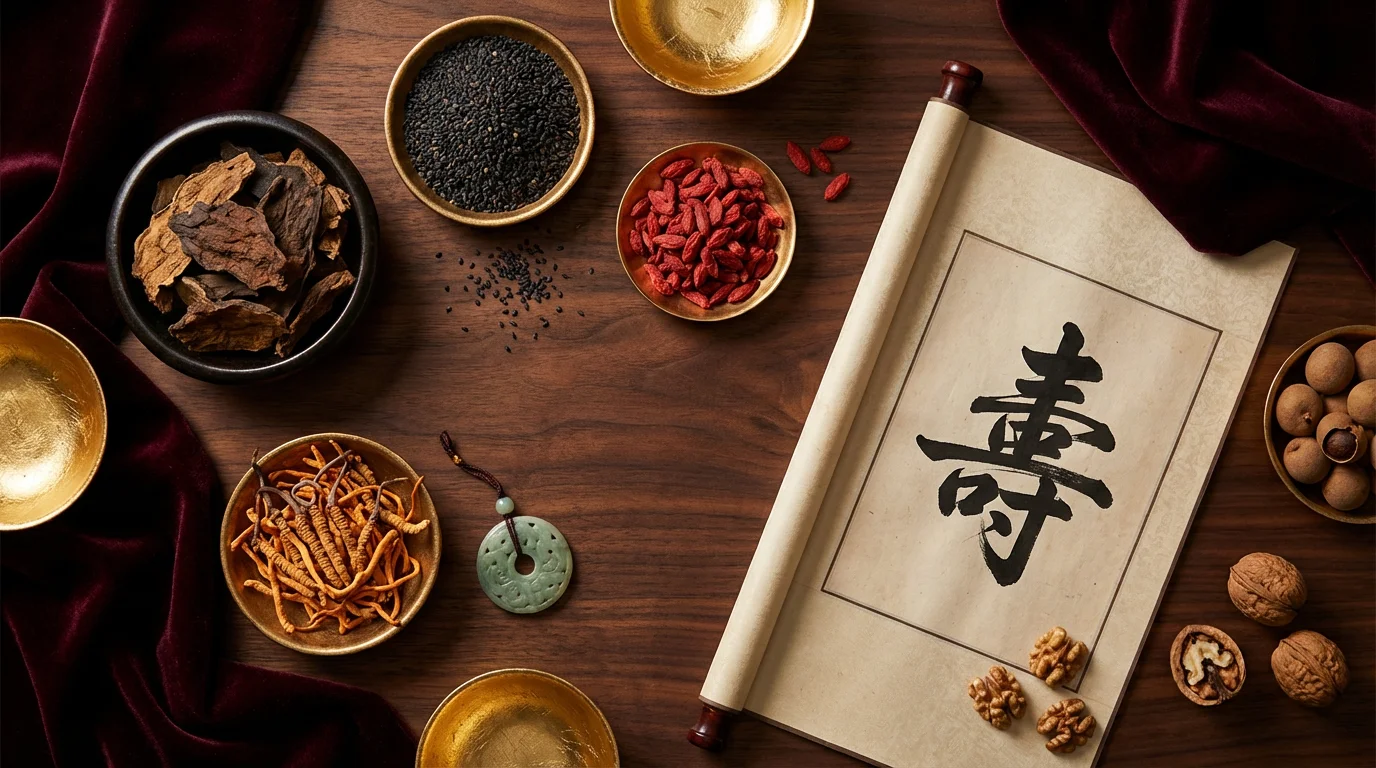
Every culture has sought the secret to a long and vital life. Traditional Chinese Medicine, drawing on over 2,500 years of clinical observation, developed one of the most sophisticated longevity frameworks ever created - one that is not about extending lifespan at any cost, but about preserving the quality of life: mental sharpness, physical strength, emotional resilience, and what TCM calls Shen - the luminous quality of a person who is truly well.
Modern longevity research - from caloric restriction to telomere biology to the gut-brain axis - is converging on conclusions that TCM codified millennia ago. Understanding the TCM framework for aging is not just historically interesting: it is practically useful right now, at any age.
The Three Treasures: The Foundation of Longevity
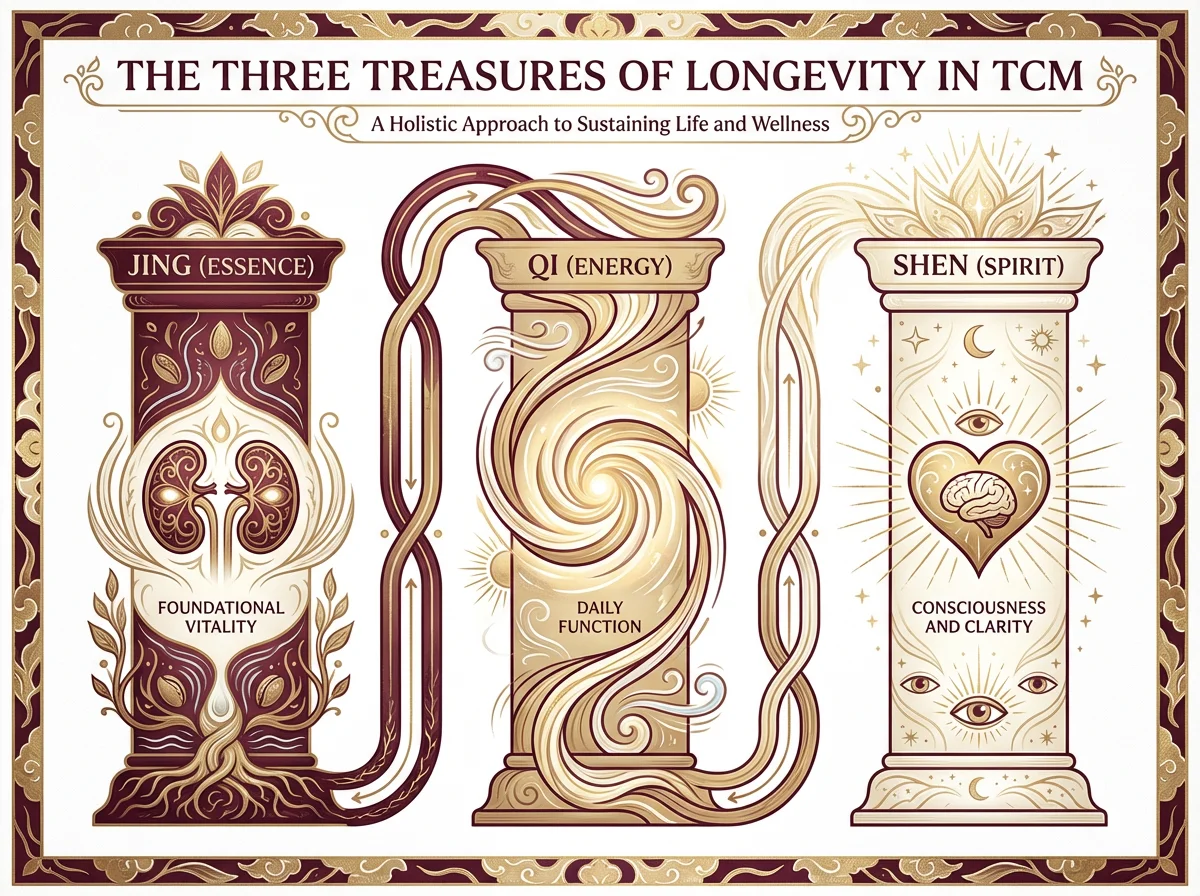
TCM organizes the body's vital resources into three interconnected treasures - Jing, Qi, and Shen. Longevity, in TCM terms, is the art of conserving and cultivating all three.
| Treasure | Chinese | What It Is | Governed By | Depleted By | Cultivated By |
|---|---|---|---|---|---|
| Jing | - (Essence) | Constitutional vitality; the biological clock; genetic potential and reproductive essence | Kidney | Overwork, excessive sex, chronic stress, poor sleep, stimulants | Sleep, Kidney tonics, Qi Gong, meditation, moderation |
| Qi | - (Energy) | Functional vitality; the daily energy that powers organ activity, immunity, and metabolism | Lung, Spleen | Irregular eating, cold foods, overexertion, illness, poor breathing | Warm diet, Qi Gong, breathing exercises, regular sleep, Astragalus |
| Shen | - (Spirit) | Mental and emotional vitality; consciousness, clarity, emotional resilience, the "light in the eyes" | Heart | Chronic stress, trauma, excessive stimulation, sleep deprivation, isolation | Meditation, meaningful connection, creative expression, Reishi, calm sleep |
How TCM Explains the Aging Process
In TCM, aging is primarily the gradual depletion of Kidney Jing - the constitutional essence inherited at birth that governs the body's biological clock. The Huangdi Neijing (Yellow Emperor's Classic) describes this process in 7-year cycles for women and 8-year cycles for men:
| Life Stage | Women (7-year cycles) | Men (8-year cycles) | Jing Status | TCM Focus |
|---|---|---|---|---|
| Youth | 7 - 1: Puberty, peak growth | 8 - 4: Puberty, peak growth | Abundant, building | Protect Jing; avoid depletion |
| Prime | 28 - 5: Peak vitality | 32 - 0: Peak vitality | Peak abundance | Maintain Qi; nourish Blood |
| Maturity | 35 - 9: Gradual Yin decline | 40 - 6: Gradual Yang decline | Beginning to decline | Nourish Yin/Yang; tonify Kidney |
| Elder | 49+: Post-menopause transition | 56+: Andropause transition | Significantly reduced | Preserve remaining Jing; calm Shen |
The Top 7 TCM Longevity Herbs
| Herb | TCM Action | Modern Research | Dose |
|---|---|---|---|
| He Shou Wu (Fo-Ti) | Tonifies Liver and Kidney Jing; nourishes Blood; reverses premature gray hair | Antioxidant, neuroprotective, improves lipid profile, extends lifespan in animal models | 6 - 2g prepared root daily; use processed (zhi) form only |
| Reishi (Ling Zhi) | Calms Shen; tonifies Qi; nourishes Heart and Liver; the "mushroom of immortality" | Immunomodulatory, anti-tumor, reduces cortisol, extends telomere length in studies | 1.5 - g powder or 3 - g extract daily |
| Astragalus (Huang Qi) | Tonifies Spleen and Lung Qi; strengthens Wei Qi; raises Yang | Telomerase activator (TA-65 derived from Huang Qi), immunostimulant, anti-aging | 15 - 0g decocted; simmer in soups; or 500mg extract |
| Wolfberry (Gou Qi Zi) | Nourishes Liver and Kidney Yin; brightens eyes; nourishes Blood | Rich in zeaxanthin (prevents macular degeneration), antioxidant, anti-glycation | 15 - 0g daily; eat raw, in tea, or in congee |
| Cordyceps (Dong Chong Xia Cao) | Tonifies Kidney Yang and Lung Qi; increases sexual vitality; strengthens physical endurance | Increases ATP production, improves VO2 max, anti-aging, immunomodulatory | 3 - g powder daily; or 1 - g extract |
| Black Sesame (Hei Zhi Ma) | Nourishes Liver and Kidney Jing; reverses premature aging; lubricates intestines | Rich in sesamin and sesamolin (antioxidant), supports liver health, reduces oxidative stress | 1 - tbsp daily; ground fresh for maximum absorption |
| Eucommia Bark (Du Zhong) | Tonifies Kidney Yang; strengthens bones, tendons and ligaments; lowers blood pressure | Antihypertensive, improves bone density, anti-inflammatory, neuroprotective | 6 - 5g decocted; or as standardized extract capsule |
The 5 Daily Longevity Practices
1. Sleep Before 11 PM - Every Night
The single highest-leverage longevity practice in TCM. The body's Jing conservation and repair occurs primarily in deep sleep before midnight. Chronic sleep deprivation is, in TCM terms, the fastest way to deplete Kidney Jing - accelerating every marker of biological aging. This is not metaphor: people who consistently sleep 7 - hours before midnight have measurably longer telomeres than those who sleep the same hours but later.
2. Qi Gong or Tai Chi - Daily
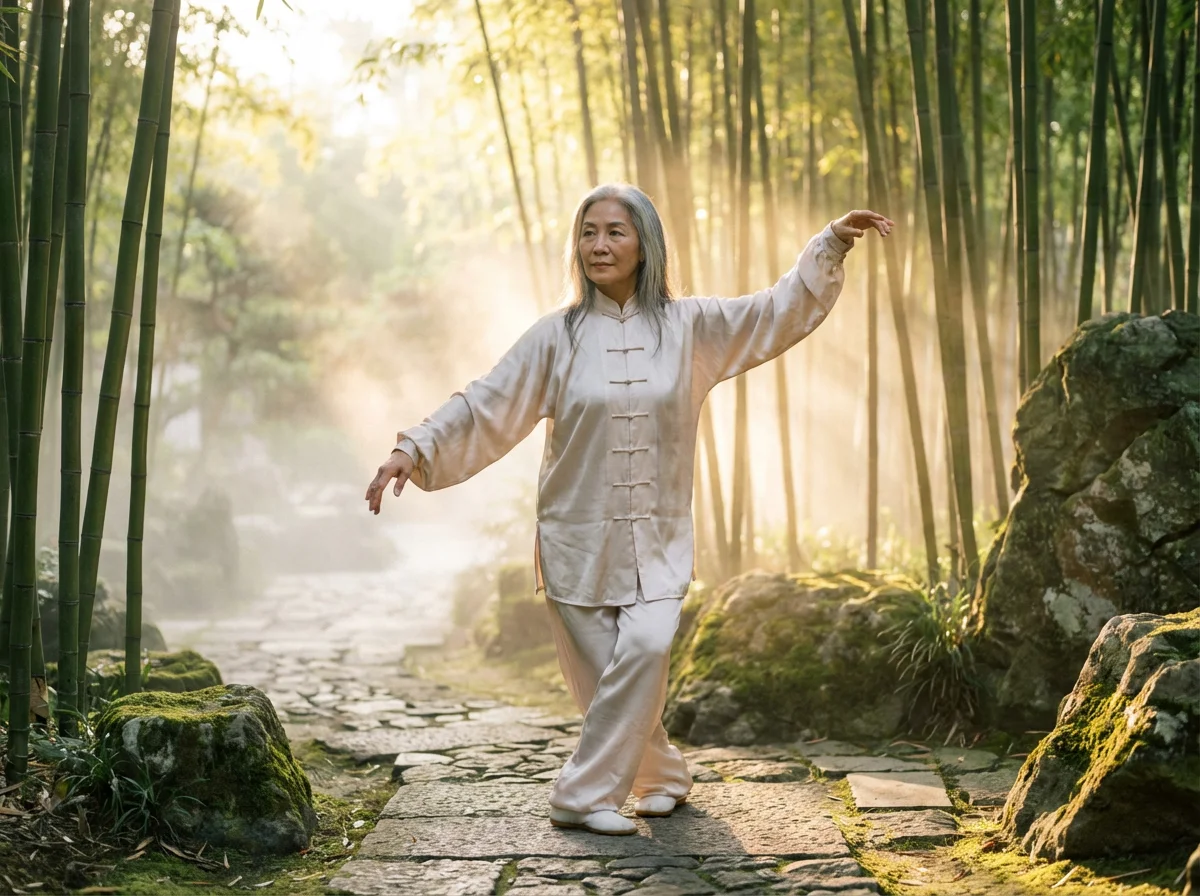
Both practices are specifically designed to cultivate Qi without depleting Jing - unlike intense exercise, which can deplete Jing in excess. The Eight Brocades (Ba Duan Jin) and Five Animals Frolics (Wu Qin Xi) are classical longevity Qi Gong sequences. Multiple RCTs show significant improvements in balance, bone density, cognitive function, immune markers, and quality of life in practitioners over 60. 20 minutes daily is sufficient.
3. The Longevity Breakfast
Warm black sesame and walnut congee with wolfberries and a few red dates - taken every morning as the Stomach's peak hour begins. This combination nourishes Kidney Jing (black sesame, walnut), Liver Blood (wolfberry, red dates), and Spleen Qi (congee base). Consistent for 3+ months, practitioners report improved hair quality, skin elasticity, and energy levels.
4. Moderate - Everything
TCM's most persistent longevity principle is moderation - in eating, in sex, in exercise, in work, in emotion. Each excess depletes a specific Treasure: overwork depletes Jing, overeating depletes Spleen Qi, emotional excess depletes Shen. The classical text states: "The sage does not treat disease after it arises, but prevents it before it begins." Applied to aging: preserve resources today rather than trying to replenish depleted ones tomorrow.
5. Cultivate Shen - Mental and Spiritual Vitality
In TCM, a person with abundant Shen is recognizable: bright eyes, clear speech, appropriate emotional responses, mental clarity. Shen is cultivated by: meaningful relationships, creative and intellectual engagement, meditation, gratitude practice, and time in nature. Shen is depleted by: chronic stress, information overload, social isolation, and existential disconnection. Modern longevity research (Blue Zones studies) confirms that social connection and sense of purpose are among the strongest predictors of healthspan.
Quick Reference: Aging Well at a Glance
| Question | Answer |
|---|---|
| What drives aging in TCM? | Gradual depletion of Kidney Jing - the constitutional essence that governs the biological clock |
| Single most important longevity habit? | Sleep before 11 PM every night - preserves Jing conservation and deep repair |
| Best longevity herb? | Reishi (Ling Zhi) - calms Shen, tonifies Qi, anti-aging at the cellular level |
| Best longevity exercise? | Qi Gong or Tai Chi - cultivates Qi without depleting Jing; backed by RCTs for healthspan |
| What is "Shen" and why does it matter? | Mental-spiritual vitality - the quality of consciousness and emotional clarity; as important as physical health in TCM longevity |
| What depletes Jing fastest? | Chronic overwork, severe sleep deprivation, excessive stress, and stimulant abuse |
Get a personalized TCM longevity assessment - understand your current Jing, Qi, and Shen status and receive a targeted protocol at Lingcore Health - your AI-powered TCM health companion.