
Elite athletes and sports medicine practitioners in China have long integrated Traditional Chinese Medicine into training and recovery protocols. TCM offers a comprehensive framework for understanding sports injuries, accelerating recovery, and building the kind of deep physical resilience that prevents re-injury - all without the side effects of NSAIDs or the limitations of passive rest.
From NBA teams to Olympic training centers, TCM modalities like acupuncture, cupping, Gua Sha, and herbal formulas are increasingly being adopted worldwide. Here's the science and practice behind why they work.
How TCM Understands Sports Injuries
In TCM, all sports injuries ultimately involve one or more of the following:
- Qi and Blood Stagnation - trauma causes local stagnation of Qi and Blood flow, manifesting as pain, swelling, and bruising
- Tendon and Sinew injury - governed by the Liver; repetitive strain depletes Liver Blood over time, weakening connective tissue resilience
- Bone and Marrow injury - governed by the Kidney; stress fractures and slow bone healing often indicate Kidney deficiency
- Wind-Cold-Damp Bi Syndrome - environmental factors (cold, humidity) penetrate weakened tissue after injury, causing chronic aching pain that worsens in cold weather
TCM Recovery Modalities: What They Do and When to Use Them
| Modality | Mechanism (TCM) | Modern Evidence | Best For | Phase |
|---|---|---|---|---|
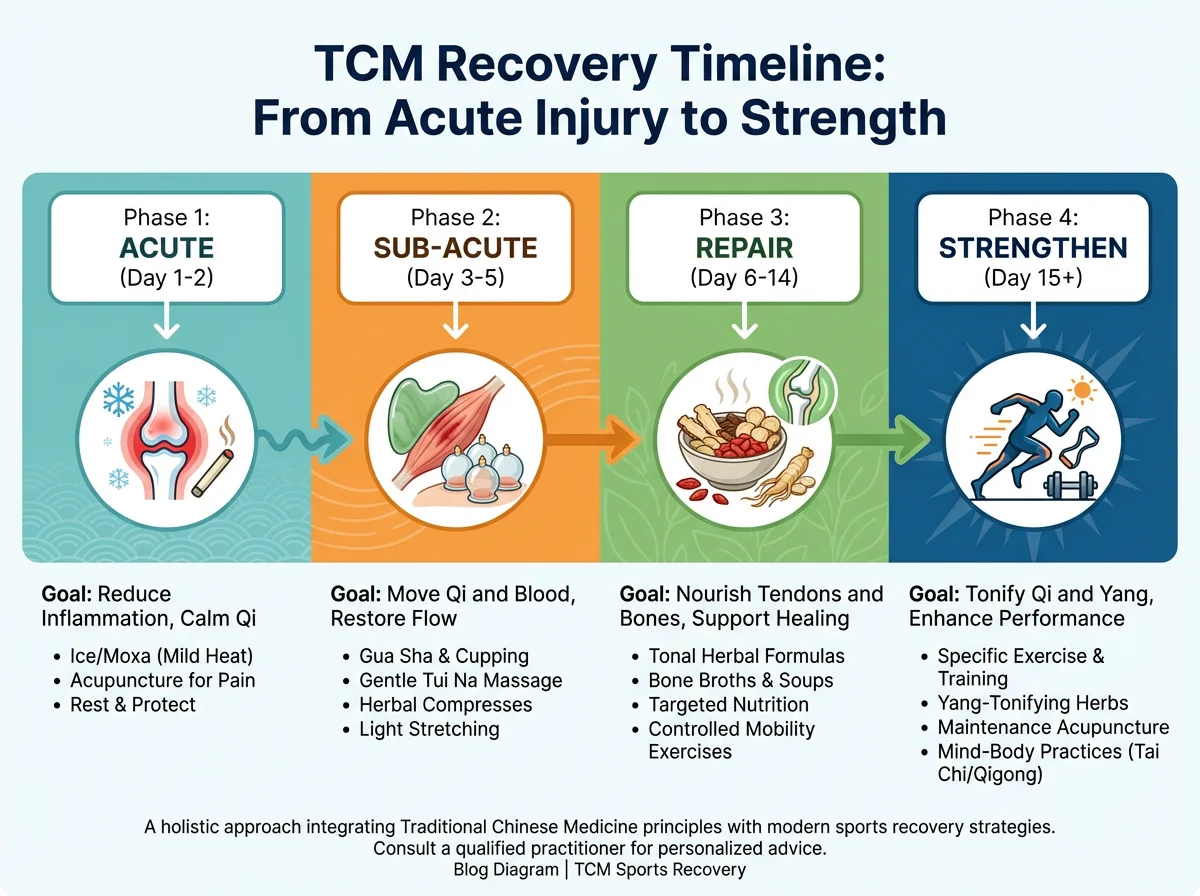
| Acupuncture | Moves Qi and Blood, releases channel blockages, reduces inflammation | Increases local blood flow, reduces inflammatory cytokines, modulates pain signaling | Muscle pain, joint injuries, tendinitis, chronic pain | All phases (gentle in acute) |
| Gua Sha | Moves Blood Stagnation, breaks up adhesions, releases surface pathogens | Increases surface microcirculation by 400%, reduces myofascial tension | Muscle tightness, upper back, IT band, hamstrings | Sub-acute and chronic |
| Cupping | Draws Qi and Blood to the surface, opens channels, expels Cold-Damp | Increases local blood circulation, reduces fascial adhesion, promotes lymphatic drainage | Back pain, muscle fatigue, respiratory issues | Sub-acute and chronic |
| Moxibustion (Moxa) | Warms channels, expels Cold-Damp, tonifies Yang Qi | Increases local temperature and circulation, anti-inflammatory via heat shock proteins | Cold-type injuries, chronic joint pain, stress fractures | Sub-acute and rehabilitation |
| Herbal Liniments (Dit Da Jow) | Moves Blood Stagnation topically, reduces swelling, relieves pain | Active compounds (camphor, menthol, salicylates) with proven analgesic and anti-inflammatory effects | Bruising, sprains, muscle soreness | Acute (no open wounds) and sub-acute |
| Tui Na Massage | Moves Qi and Blood through meridian channels, relaxes sinews | Reduces muscle tension, improves ROM, stimulates lymphatic flow | Muscle recovery, joint stiffness, sports massage | Sub-acute and maintenance |
TCM Recovery by Injury Type
| Injury Type | TCM Diagnosis | Primary Treatment | Key Herbs / Formula | Acupressure Points |
|---|---|---|---|---|
| Acute Sprain / Strain | Blood Stagnation, Qi blockage | Dit Da Jow liniment, rest, light acupuncture | San Qi (Notoginseng), Ru Xiang, Mo Yao | Ashi points (local), SP10 |
| Tendinitis / Tendinopathy | Liver Blood Deficiency + local Blood Stagnation | Acupuncture, Gua Sha, Liver Blood tonics | Si Wu Tang + San Qi | LV3, GB34, local Ashi |
| Muscle Soreness (DOMS) | Qi and Blood Stagnation in muscles | Gua Sha, cupping, warm bath with Mugwort | Dit Da Jow topically | ST36, SP6, BL40 |
| Stress Fracture | Kidney deficiency (Yin or Yang) | Moxa on local points, Kidney tonics, rest | You Gui Wan (Yang def.) or Liu Wei Di Huang Wan (Yin def.) | KD3, BL23, RN4 |
| Chronic Joint Pain | Wind-Cold-Damp Bi Syndrome | Moxa, cupping, warming herbs | Juan Bi Tang, Du Huo Ji Sheng Wan | Local + ST36, SP9 |
| Lower Back Pain | Kidney deficiency + Blood Stagnation | Acupuncture, Tui Na, Kidney tonics | Du Zhong (Eucommia), Ba Ji Tian | BL23, BL40, GV4, KD3 |
TCM Daily Recovery Protocol for Athletes
Morning (Pre-Training)
- Warm ginger and jujube tea to activate Spleen Qi and warm channels
- 5 minutes Qi Gong or dynamic stretching to open channels before loading
- Acupressure on ST36 (Zusanli) for 90 seconds each leg - builds Qi and digestive capacity
Post-Training
- Apply Dit Da Jow or herbal liniment to any areas of acute soreness (no open skin)
- Gua Sha on tight muscle groups (back, hamstrings, IT band) - 5 - 0 minutes per area
- Warm bath or foot soak with Mugwort (Ai Ye) - promotes channel circulation and reduces DOMS
Evening (Recovery)
- San Qi (Notoginseng) powder in warm water - the single most important herb for athletic recovery; moves Blood, reduces inflammation, accelerates tissue repair
- Bone broth or black sesame congee - nourishes Kidney Jing and Liver Blood, the foundations of tendon and bone health
- Sleep before 11 PM - Liver Blood regeneration window; non-negotiable for athletic recovery
The TCM Performance Edge: Beyond Recovery
| Goal | TCM Strategy | Key Herb / Formula |
|---|---|---|
| Increase endurance | Tonify Lung and Kidney Qi | Cordyceps (Dong Chong Xia Cao), Huang Qi (Astragalus) |
| Build muscle (hypertrophy) | Strengthen Spleen Qi, nourish Blood | Ba Zhen Tang (Eight Treasures), yam, beef |
| Speed recovery | Move Blood Stagnation, reduce inflammation | San Qi (Notoginseng), Dan Shen |
| Prevent overtraining | Protect Kidney Jing (essence) | He Shou Wu, Gou Qi Zi (Wolfberry), rest |
| Mental focus / performance anxiety | Calm Shen, support Heart | Ling Zhi (Reishi), Suan Zao Ren |
Quick Reference: TCM Sports Recovery at a Glance
| Question | TCM Answer |
|---|---|
| Single best herb for injury recovery? | San Qi (Notoginseng) - moves Blood, reduces swelling, accelerates tissue repair |
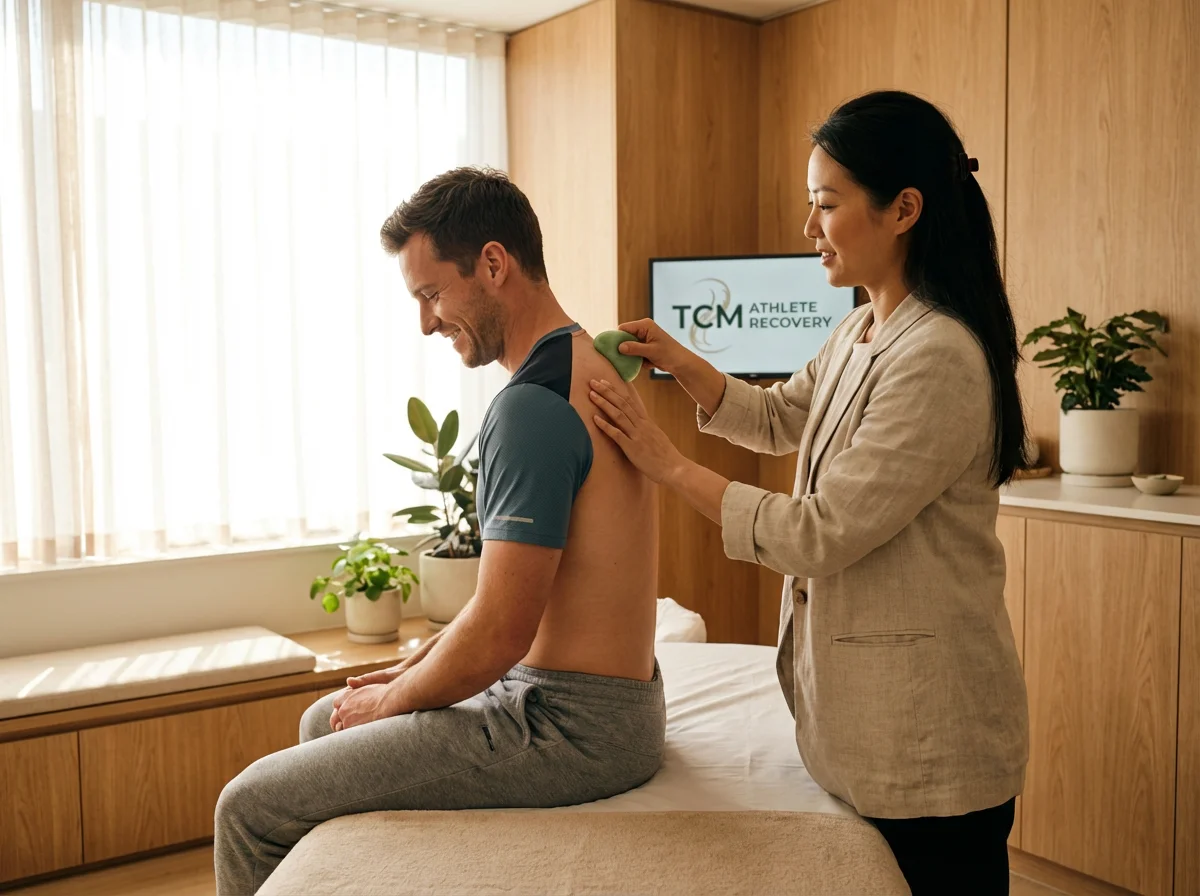
| Best modality for muscle soreness? | Gua Sha - increases local circulation by 400%, reduces DOMS within 24 hours |
| Best modality for chronic joint pain? | Moxibustion - warms channels, expels Cold-Damp, reduces chronic inflammation |
| What governs tendon health in TCM? | The Liver - nourishing Liver Blood is foundational for tendon resilience and repair |
| What governs bone health in TCM? | The Kidney - Kidney Jing is the source of bone marrow and skeletal integrity |
| How long for TCM to show results in sports recovery? | Gua Sha / cupping: 24 - 2 hours. Herbal formulas: 2 - weeks for chronic conditions |
Get a personalized TCM athletic recovery and performance optimization plan at Lingcore Health KineticQi - your AI-powered TCM companion for movement and recovery.