
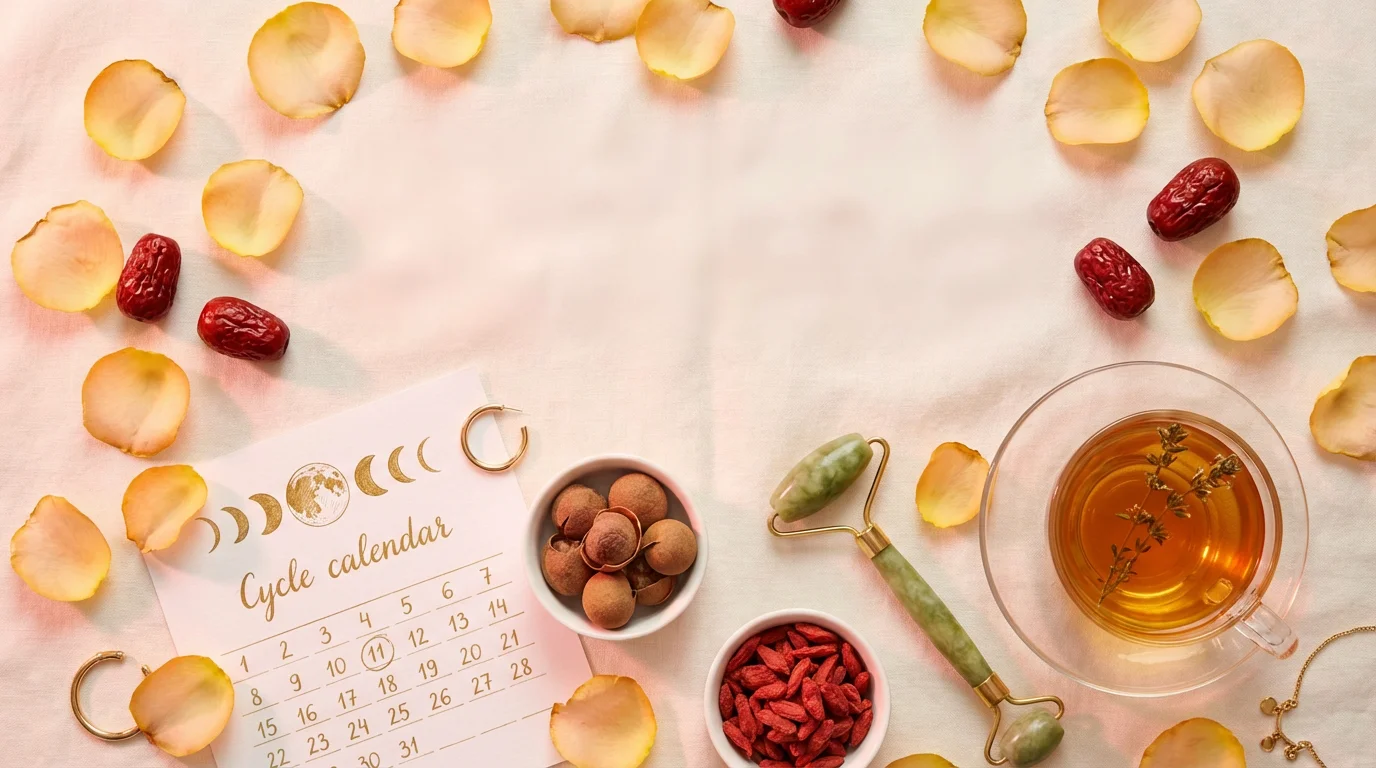
If you've ever felt like your energy, mood, appetite, and focus change dramatically throughout the month - you're not imagining it. Your body is cycling through four distinct hormonal phases every month, and Traditional Chinese Medicine (TCM) mapped this cycle with remarkable precision over 2,000 years ago.
TCM doesn't just acknowledge the menstrual cycle - it builds an entire framework of nutrition, herbs, acupressure, and lifestyle practices around each phase. This approach, increasingly recognized as "cycle syncing" in modern wellness, is something TCM practitioners have applied for millennia.
How TCM Views the Menstrual Cycle
In TCM, the menstrual cycle is governed by the interplay of Yin and Yang, and the health of three organ systems: the Liver (governs blood storage and smooth Qi flow), the Kidney (governs reproductive essence and hormonal foundation), and the Spleen (governs blood production and digestive energy).
A healthy cycle, in TCM terms, reflects a balanced and rhythmic transition between Yin and Yang phases. Disruptions - irregular periods, PMS, cramping, heavy or scanty flow - are signals that one or more of these organ systems is out of balance.
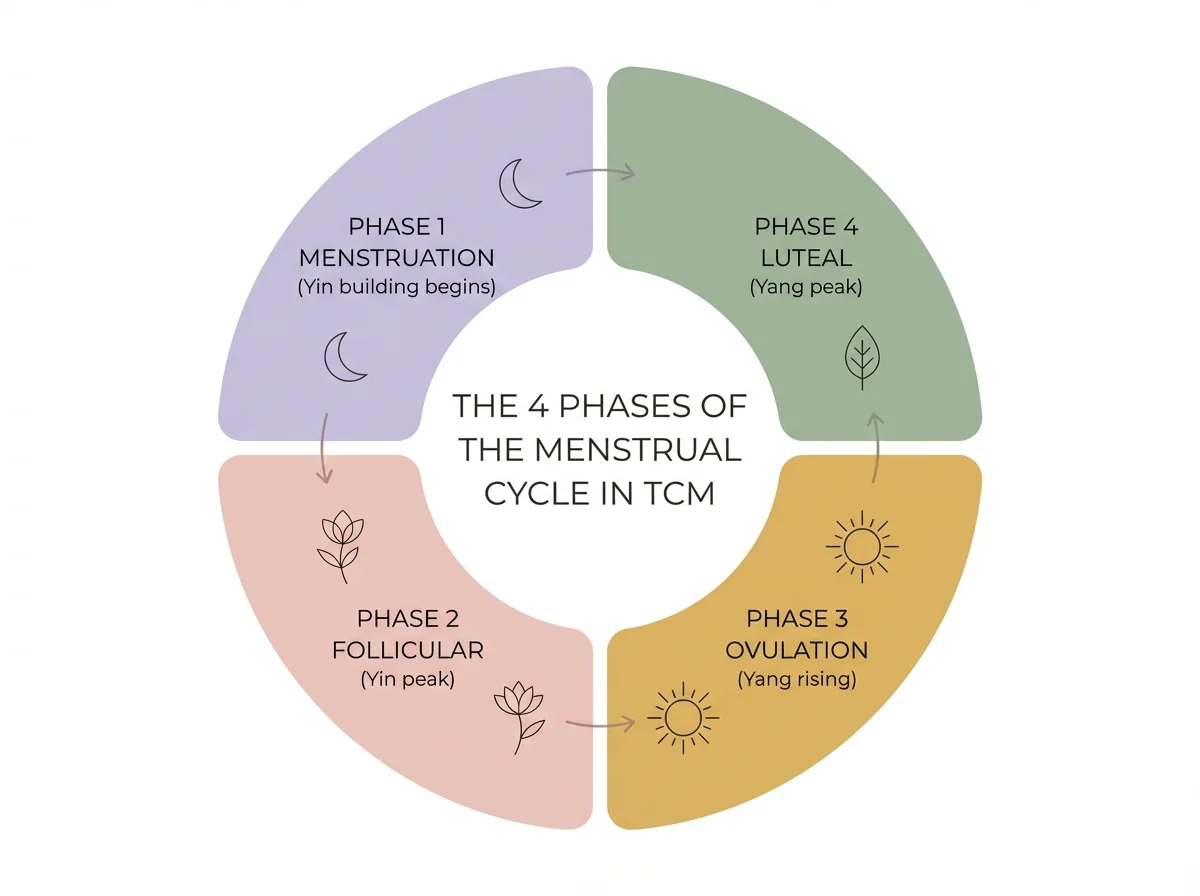
The 4 Phases of the Menstrual Cycle in TCM
Phase 1 - Menstruation (Days 1 - ): Release and Renewal
TCM energy: Yin begins to build. Blood moves downward and outward.
Key organ: Liver (ensures smooth blood flow, prevents stagnation)
Common imbalances: Cramping (Blood Stagnation), heavy flow (Blood Heat), scanty flow (Blood Deficiency)
This phase is about release - not just physically, but energetically. In TCM, the Liver must allow blood to flow freely. When Liver Qi is stagnant (often from chronic stress), menstruation becomes painful, clotted, or emotionally turbulent.
Phase 2 - Follicular (Days 6 - 3): Yin Building
TCM energy: Yin and Blood are being replenished after menstruation.
Key organ: Kidney and Spleen (Kidney Yin nourishes the follicle; Spleen produces new blood)
Common imbalances: Fatigue, brain fog, dry skin (Yin or Blood Deficiency)
This is a time of restoration. The body is rebuilding its Yin foundation - the fluid, cool, restorative energy that supports egg development. Eating blood-nourishing foods during this phase is one of the most impactful dietary interventions in TCM gynecology.
Phase 3 - Ovulation (Days 14 - 6): Yang Rises
TCM energy: Yin peaks and transforms into Yang. Qi moves upward and outward.
Key organ: Kidney Yang (provides the "spark" for ovulation)
Common imbalances: Absent ovulation, mid-cycle pain, low libido (Kidney Yang Deficiency)
Ovulation requires a surge of Yang energy - warm, active, expansive. In TCM, Kidney Yang is the fire that triggers the release of the egg. Women with Kidney Yang Deficiency often experience anovulation, low basal body temperature, and low energy around ovulation.
Phase 4 - Luteal (Days 17 - 8): Yang Peak and Transition
TCM energy: Yang peaks, then begins to decline as the cycle prepares to repeat.
Key organ: Liver (must remain smooth; any stagnation here causes PMS)
Common imbalances: PMS, breast tenderness, irritability, bloating (Liver Qi Stagnation)
This is where most women feel the greatest imbalance. As Yang energy peaks and then drops, the Liver must ensure a smooth transition. When it can't - due to stress, poor diet, or insufficient sleep - Liver Qi stagnates, producing the classic PMS constellation: irritability, bloating, breast tenderness, and mood swings.
TCM Cycle Syncing: Phase-by-Phase Guide
| Phase | TCM Focus | Foods to Favor | Foods to Avoid | Key Herbs | Acupressure |
|---|---|---|---|---|---|
|
Menstruation (Days 1 - ) |
Move Blood, ease flow | Brown sugar ginger tea, black fungus, turmeric, rose petals | Cold foods, raw salads, ice water | Yi Mu Cao (Motherwort), Dang Gui | SP8 (Diji), LV3 (Taichong) |
|
Follicular (Days 6 - 3) |
Nourish Yin and Blood | Red dates, black sesame, eggs, beets, leafy greens, bone broth | Spicy foods, alcohol, caffeine excess | Shu Di Huang, Bai Shao (White Peony) | SP6 (Sanyinjiao), ST36 (Zusanli) |
|
Ovulation (Days 14 - 6) |
Support Yang, move Qi | Walnuts, lamb, leeks, ginger, quinoa | Cold, damp foods; excessive dairy | Tu Si Zi (Cuscuta), Ba Ji Tian | KD3 (Taixi), RN4 (Guanyuan) |
|
Luteal (Days 17 - 8) |
Soothe Liver Qi, prevent stagnation | Rose tea, hawthorn, citrus peel, celery, chamomile | Alcohol, processed sugar, excessive salt | Xiao Yao San formula, Chen Pi | LV3 (Taichong), PC6 (Neiguan) |
The Most Common TCM Hormonal Imbalance Patterns
| Pattern | Key Symptoms | Likely Cause | TCM Approach |
|---|---|---|---|
| Liver Qi Stagnation | PMS, irritability, breast tenderness, irregular cycle, sighing | Chronic stress, emotional suppression, irregular sleep | Xiao Yao San, LV3 acupressure, aerobic exercise, rose tea |
| Blood Deficiency | Scanty periods, pale blood, fatigue, dizziness, poor memory | Poor nutrition, overwork, chronic blood loss | Dang Gui, red dates, black sesame, Si Wu Tang formula |
| Kidney Yin Deficiency | Night sweats, hot flashes, dry skin, short cycles, restless sleep | Aging, overwork, excessive stress, insufficient rest | Liu Wei Di Huang Wan, black foods (black sesame, black beans) |
| Kidney Yang Deficiency | Cold extremities, low libido, anovulation, delayed cycle, fatigue | Constitutional tendency, overexposure to cold, exhaustion | You Gui Wan, warming foods, moxa on RN4, ginger lamb soup |
| Blood Stagnation | Painful periods, dark clotted blood, fixed abdominal pain | Cold exposure during menstruation, old trauma, Qi stagnation | Yi Mu Cao, SP8 acupressure, warm compress, avoid cold |
5 Daily Habits for Hormonal Balance the TCM Way
1. Eat Warm, Cooked Foods - Especially During Menstruation
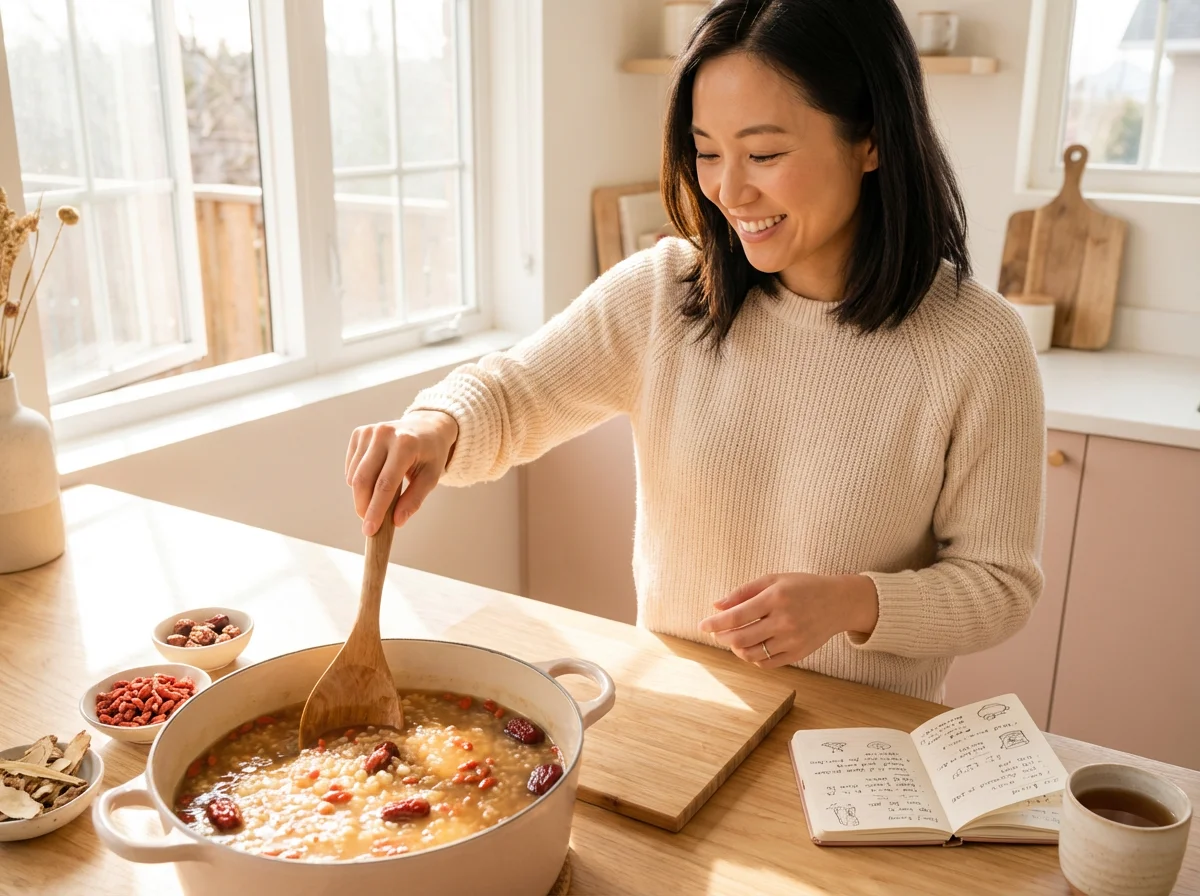
The Spleen, which produces Blood in TCM, is weakened by cold and raw foods. A bowl of warm congee with red dates and wolfberries does more for your hormonal health than a cold green smoothie - especially in the first days of your cycle. Aim to eat at least 80% cooked, warm foods throughout your cycle.
2. Sleep Before 11 PM
The Liver's peak regeneration window is 11 PM - AM. Consistently sleeping after midnight depletes Liver Blood - the foundation of a healthy menstrual cycle. This single habit, maintained over months, has a measurable impact on PMS severity, flow quality, and cycle regularity.
3. Manage Stress as a Medical Priority
In TCM, chronic stress is not just psychological - it is the primary driver of Liver Qi Stagnation, the most common hormonal imbalance pattern in modern women. Practices that move Qi include brisk walking, dancing, Qi Gong, journaling, and acupressure on LV3 (Taichong) for 90 seconds daily.
4. Reduce Cold Beverages
Iced drinks directly suppress Spleen Yang and impair blood production. This is not just TCM dogma - many women report significant improvements in cramping and flow quality within one to two cycles of switching from cold to room-temperature or warm beverages.
5. Track Your Cycle as a Diagnostic Tool
Your cycle is a monthly report card of your internal health. Track: cycle length, flow color and volume, days of cramping, mood shifts by day, energy levels, and skin changes. Over three months, patterns emerge that reveal your specific TCM imbalance - making targeted intervention far more effective.
Quick Reference: TCM Hormonal Health at a Glance
| Question | TCM Answer |
|---|---|
| What governs the menstrual cycle? | Liver, Kidney, and Spleen - and the balance of Yin and Yang |
| What causes PMS in TCM? | Liver Qi Stagnation - often from chronic stress and poor sleep |
| What causes painful periods? | Blood Stagnation - often from cold exposure or pre-existing Qi stagnation |
| What causes irregular cycles? | Kidney deficiency (Yin or Yang), Liver Qi Stagnation, or Blood Deficiency |
| Best single food for women's hormonal health? | Red dates (Da Zao) - nourish Blood, tonify Spleen, calm the Shen |
| Best single lifestyle change? | Sleep before 11 PM - protects Liver Blood during its regeneration window |
| How long before TCM interventions show results? | Typically 2 - menstrual cycles for noticeable improvement |
The Bottom Line
TCM offers a remarkably sophisticated map of women's hormonal health - one that treats the menstrual cycle not as a monthly inconvenience, but as a vital sign. By understanding which phase you're in and which organ systems need support, you can eat, sleep, move, and live in a way that works with your cycle rather than against it.
The key facts to remember:
- The menstrual cycle has 4 distinct TCM phases, each requiring different nutritional and lifestyle support
- Liver Qi Stagnation (from stress) is the most common cause of PMS in modern women
- Blood and Yin nourishment in the follicular phase is the foundation of a healthy cycle
- Sleeping before 11 PM and eating warm foods are the two highest-impact daily habits
- TCM interventions typically show results within 2 - cycles when applied consistently
Get a personalized TCM hormonal health assessment and cycle-synced wellness plan at Lingcore Health EssenceHer - your AI-powered TCM companion for women's wellness.