

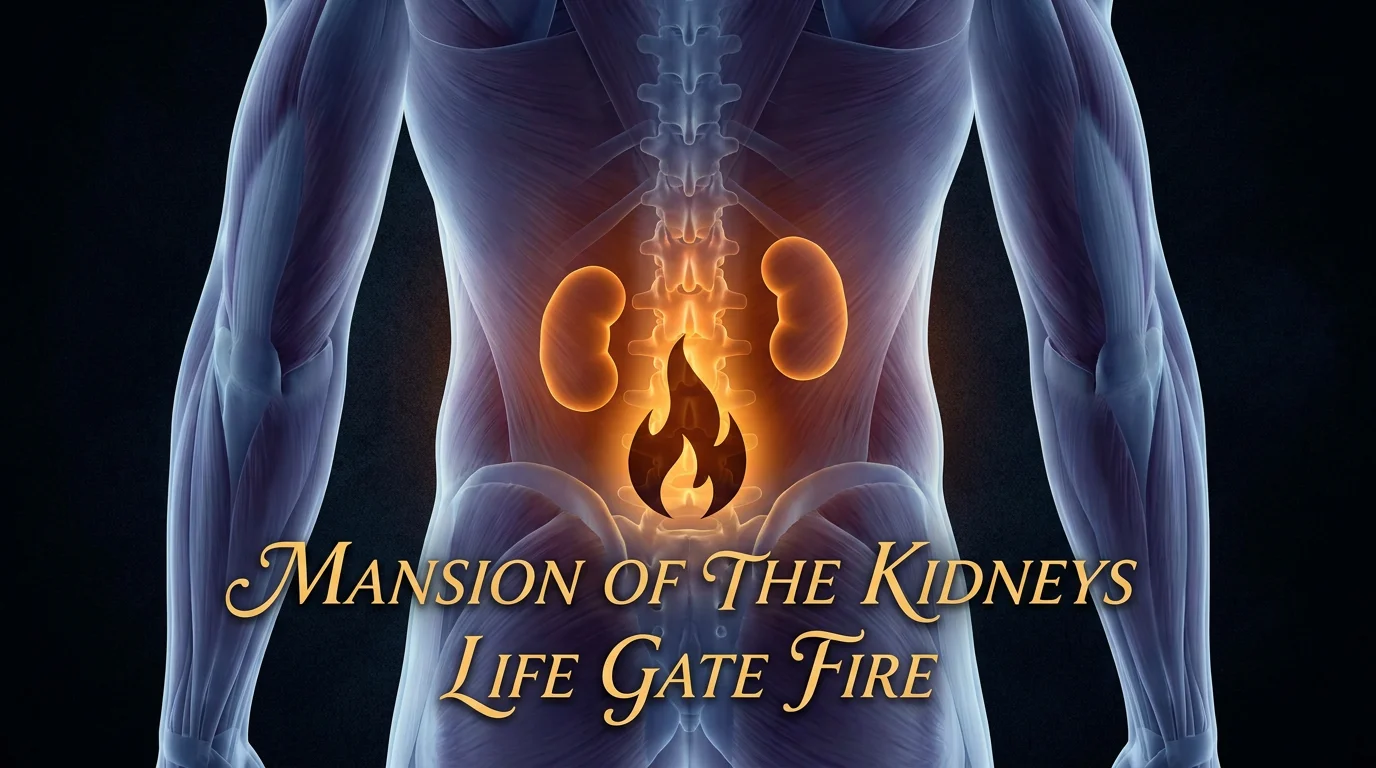
In the high-pressure world of professional athletics and corporate leadership, the lower back is often the first place to 'break.' We see it as a mechanical issue--a result of poor ergonomics, sitting too long, or lifting a heavy weight with improper form. While these physical factors are real, Traditional Chinese Medicine (TCM) looks deeper. The lower back is known as the 'Mansion of the Kidneys.' In this system, your spine is not just a column of bone; it is the structural scaffolding for your internal battery. If your lower back is cold, stiff, or weak, it is a direct signal that your internal reserves are being drained. To maintain true structural resilience, you must keep the 'Life Gate' (Mingmen) fire burning bright.
The Energetic Foundation: Why the Back is the "Mansion"
In TCM, the Kidneys are the most vital organ system. They store our Jing (Essence)--the ancestral energy we are born with and the deep reserves we use for reproduction, growth, and aging. The Kidneys 'govern' the bones, and their meridian runs directly through the lower back. Therefore, any pathology in the Kidneys will inevitably manifest in the lumbar region.
When we call the lower back a 'mansion,' we are describing a sanctuary that must be kept warm and protected. In TCM theory, the Kidneys are the 'Root of Life.' They provide the 'Yang' (the fire) for the entire body. If the mansion becomes cold, the energy stagnates, the muscles tighten to protect the core, and the result is the chronic, 'aching' stiffness that so many professionals experience. This isn't just a muscle knot; it's a depletion of the pilot light that keeps your structural system supple.
The Internal Battery and the "Life Gate" Fire
Located directly between the two kidneys (at the level of the second lumbar vertebra) is a point known as Mingmen, or the 'Gate of Life.' This is the source of all 'Fire' in the body. It is the energetic spark that drives digestion, circulation, and immune function. Think of Mingmen as the pilot light of your internal boiler. When this light is strong, the lower back is warm, flexible, and resilient. When the light flickers--due to overwork, stress, or exposure to cold--the lower back becomes vulnerable.
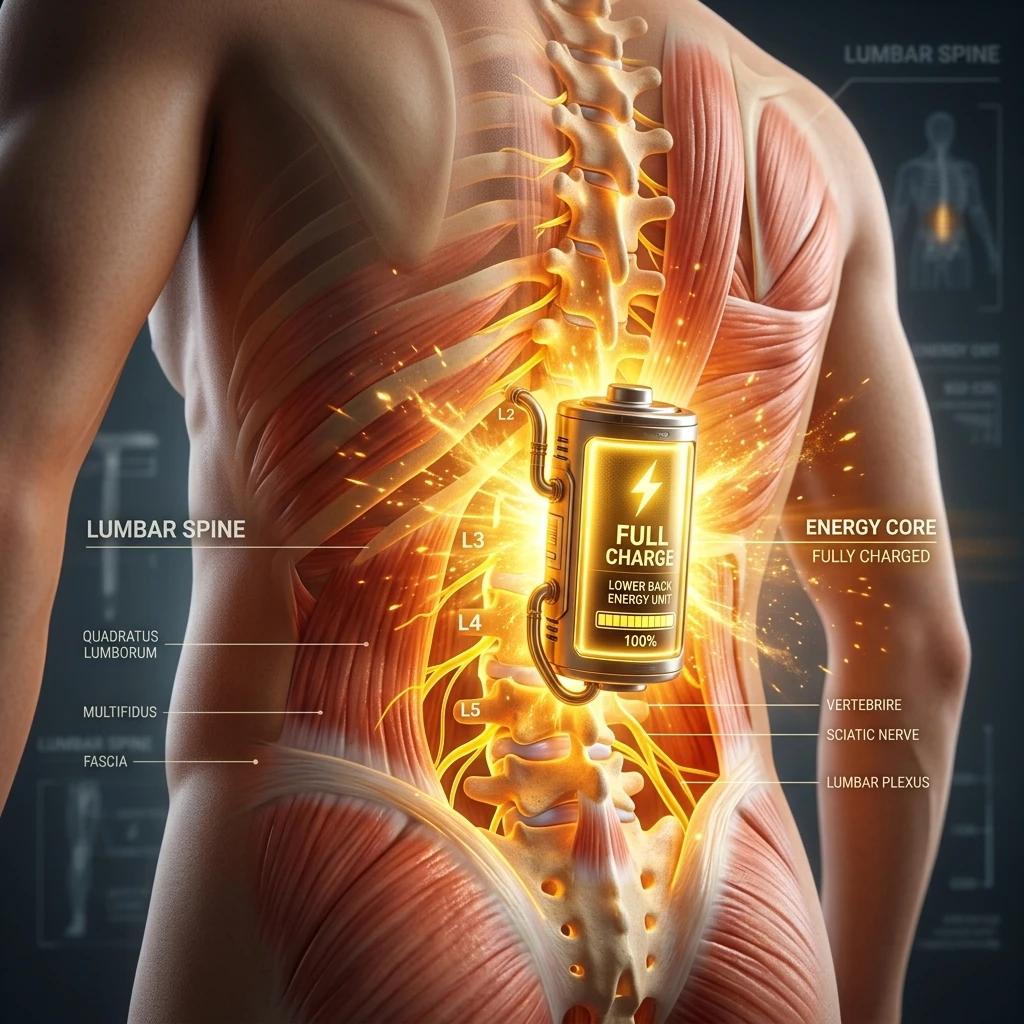
A common sign of 'Kidney Yang Deficiency' (a weak internal battery) is a lower back that feels cold to the touch or stiffness that feels significantly better after applying a heating pad. If your back 'goes out' frequently or feels like it 'gives way' under pressure, you are likely dealing with a lack of Mingmen fire. Your structural resilience is only as strong as the battery that powers it.
Case Study: The "Cold Core" High-Performer
Meet David, a 42-year-old software engineer and amateur marathon runner. David was in excellent cardiovascular shape, but he suffered from persistent lower back stiffness every morning. He spent 8 to 10 hours a day in an air-conditioned office, often sitting in a chair that didn't support his lumbar curve. To 'cool down' after his runs, he would take ice baths--a practice he thought would help recovery.
From a TCM perspective, David was committing two major 'crimes' against his Kidneys. First, the air conditioning was blowing cold air directly onto his 'Mansion of the Kidneys' all day, allowing 'Cold Pathogens' to seep into his joints. Second, the ice baths were 'freezing' his Mingmen fire. Cold causes contraction. By icing his back and core, he was stagnating the very Blood and Qi needed to repair his muscles. Once David swapped the ice for warm compresses, started wearing a 'Haramaki' (a traditional Japanese belly and back warmer), and began nourishing his Kidney Yang with warm foods, his morning stiffness vanished, and his running times actually improved because his 'Internal Battery' was no longer being drained by the cold.
The Meridian Clock Logic: Kidney Time (5:00 PM - 7:00 PM)
The Kidney meridian is at its peak between 5:00 PM and 7:00 PM. This is the transition time between the high-output 'Yang' energy of the day and the restorative 'Yin' energy of the night. In our modern culture, this is often when we are most stressed--finishing work, commuting, or doing high-intensity evening workouts.
However, to preserve your structural health, this window should be used for Qi Accumulation. Pushing yourself too hard during Kidney time is like running your car on an empty tank. It forces the body to tap into its 'Jing' reserves, which leads to long-term structural decay. If you have lower back pain that gets worse in the evening, your body is telling you that you've overdrawn your account. The best practice during this time is gentle movement, warmth, and hydration.
The 3-Step "Reignite" Protocol for Structural Resilience
To restore your lower back and protect your 'mansion,' follow this high-performance TCM protocol.
Step 1: External Heat (Protecting the Mansion)
Cold is the primary enemy of the Kidneys. In TCM, 'Cold stays in the bones.' If you work in an air-conditioned office or live in a cold climate, your first priority is insulation.
- Action: Apply a warm compress or moxibustion (heat therapy) to the lower back for 15 minutes every evening.
- Action: Keep your feet warm. The Kidney meridian begins on the sole of the foot (the 'Bubbling Spring' point). Standing on cold floors with bare feet draws cold directly into the Kidney system and the lower back.
Step 2: Point Activation (Boosting the Battery)
You can manually 'charge' your battery by stimulating specific acupoints that connect directly to the Kidney system.
- Action: Shenshu (Bladder 23). These points are located on the lower back, about two finger-widths on either side of the spine at the level of the waist. Rub these points with your fists until they feel warm. This 'wakes up' the Kidney Qi and increases local blood flow.
- Action: Mingmen (Governor Vessel 4). Locate the point on the spine directly between the Shenshu points. Gently breathing 'into' this point during meditation helps anchor the Qi and ignite the internal fire.
Step 3: Internal Cultivation (Nourishing the Fire)
Your internal battery needs the right 'fuel' to stay charged. This involves dietary choices that support Kidney Yang and movement that keeps the 'Gate' open.
- Action: Eat 'Black' and 'Salty' (naturally salty) foods. In TCM, the color black corresponds to the Kidneys. Black beans, black sesame seeds, seaweed, and walnuts are all 'Kidney Tonics.'
- Action: The Tai Chi Waist. Practice the 'Swing' or 'Knocking on the Gate of Life.' Stand with feet shoulder-width apart and gently swing your arms so they tap against your lower back and lower abdomen. This movement 'massages' the internal organs and ensures that the Qi in the lower back doesn't become stagnant.
The Ancestral Connection: Jing and the Spine
TCM teaches that the Kidneys store Pre-Natal Jing--the blueprint of your life, similar to what we call DNA today. The spine is the physical conductor for this essence. When your lower back is strong and warm, your 'Jing' is well-protected. However, the Kidneys also store Post-Natal Jing, which is the energy we gather from food and breath. By warming the 'Mansion of the Kidneys,' you are effectively creating a protective buffer for your genetic potential. A flexible, warm spine is the hallmark of longevity and the primary defense against the premature aging that often starts in the lumbar discs.
The Fear-Kidney Loop: Emotional Resilience
The Kidneys are energetically linked to the emotion of Fear. When we live in a state of chronic high-stress or 'Hyper-Vigilance,' our adrenals (which sit atop the Kidneys) are constantly pumping out cortisol. In TCM, this 'scorches' the Kidney Yin and depletes the Kidney Yang. This is why many people find that their lower back 'locks up' during periods of extreme professional or personal stress. To heal the back, you must also address the fear. Practices that ground the energy--such as deep abdominal breathing or 'Earthing'--help signal to the Kidney system that it is safe to 'let go' of the tension in the mansion walls.
Advanced Hack: The Haramaki Strategy
For those who work in high-stress, cold environments (like modern offices or hospitals), the Haramaki is a game-changer. It is a simple cloth tube worn around the midsection to keep the 'Mingmen' and 'Kidneys' warm. By maintaining this 'Core Heat,' you prevent the body from having to waste energy trying to maintain its temperature, thereby preserving your 'Internal Battery' for higher-level cognitive and physical performance.

The Structural Maintenance Checklist
Long-term spine health requires consistent investment in your Kidney energy. Use this checklist to ensure your 'Mansion' remains a fortress of vitality:
- Hydration: Drink warm or room-temperature water. Iced water shocks the Kidney system and 'puts out' the fire.
- Posture: When sitting, ensure your lower back is supported to prevent the Mingmen point from being 'crushed' or closed off.
- Rest: The Kidneys are the first organ to suffer from lack of sleep. Aim for 7-8 hours to allow the 'Jing' to replenish.
- Emotional Balance: Fear is the emotion of the Kidneys. Chronic anxiety and 'fight or flight' states drain the adrenal system (which TCM considers part of the Kidney complex).
Our KineticQi AI coach provides structural health protocols to ensure your spine remains strong and your energy remains high.
>> Unlock Your AI Performance Coach <<
Medical Disclaimer: The information provided in this article is for educational and informational purposes only and is not intended as medical advice, diagnosis, or treatment. Always seek the advice of your physician or other qualified health provider. For more details, visit our Medical Disclaimer page.